if demons existed in real life, what could they do to still trick people with stuff
this reminded me of this meme:
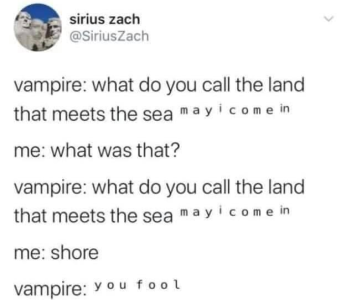
now for the not so fun/funny fact:
the Civil Proceeding Benchbook for Michigan states the elements of a contract as such:
“The essential elements of a contract are parties competent to contract, a proper subject matter, legal consideration, mutuality of agreement, and mutuality of obligation.” Mallory v Detroit, 181 Mich App 121, 127 (1989). “An implied contract must also satisfy the elements of mutual assent and consideration.” Id.
as to the construction of a contract:
“In determining contractual rights and obligations, a court must look to the intention of the parties, and
a contract should always be construed so that it carries that intention into effect. When the words of a written contract are clear and unambiguous and have a definite meaning, the court has no right to look to extrinsic evidence to determine their intent. Indeed, if the language of the entire contract is clear and unambiguous, there is no room for construction by the courts, and in such case, t
he language must be held to express the intention of the parties and the court need not search for meanings nor indulge in inferences as to the intention of the parties.”
DeVries v Brydges, 57 Mich App 36, 41 (1974).22 See also C-Spine Orthopedics, PLLC v Progressive Mich Ins Co, ___ Mich ___, ___ (2025) (“noting that extrinsic evidence may only be considered when contractual language is ambiguous”), citing In re Smith Trust, 480 Mich 19, 24 (2008).
“A contract is ambiguous only if its language is reasonably susceptible to more than one interpretation. If the terms of the release are unambiguous, contradictory inferences become ‘subjective, and irrelevant,’ and the legal effect of the language is a question of law to be resolved summarily.” Gortney v Norfolk & Western R Co, 216 Mich App 535, 540-541 (1996) (internal citations omitted).
“Where a contract is to be construed by its terms alone, it is the duty of the court to interpret it; but where its meaning is obscure and its construction depends upon other and extrinsic facts in connection with what is written, the question of interpretation should be submitted to the jury, under proper instructions.” Klapp v United Ins Group Agency, Inc, 468 Mich 459, 469 (2003) (quotation marks and citation omitted).
Generally, the language of a contract is to be construed against its drafter. Petovello v Murray, 139 Mich App 639, 642 (1984). However, construing a contract against the drafter to resolve ambiguous contract language (called the rule of contra proferentem) is applicable only if the intent of the parties cannot be discerned through the use of all conventional rules of interpretation, including an examination of relevant extrinsic evidence. Klapp, 468 Mich at 472.
It probably differs from state to state, or country by country.
but it can act as a basis, I guess
(** edit to add: I am not a contract lawyer or a lawyer of any kind, btw**)