AI discussion broken off the not happy thread

I think we really need to clear up some things in this discussion.

"AI" is a very broad umbrella term for many technologies. Talking about AI as a general technology is largely unhelpful. AI models have existed for a very, very long time. A decision tree is a model that falls under the umbrella term of "AI". They are algorithms that date back to 1963! It's very wrong to compare decision trees to large language models. It's like comparing a Nokia brickphone to a modern smartphone. Yes, technically, they are both phones, but the difference between them is stark.

Of course, there are many more AI technologies. Some more advanced than others. But it isn't even a question of how advanced AI's are. Some have different purposes than others.

Let's get something straight: These days, when the average person says the word "AI", they are most certainly referring to things like Midjourney and ChatGPT. These models fall under the category of Generative AI, or just GenAI for short. Some people are nice enough to say GenAI when they are discussing the technology. I shall award people who do this with a gold star because it's very helpful, and it makes things super clear and focused.

Now, let's backtrack to some real science. In 2017, Google released a revolutionary paper called "Attention is All You Need". The paper introduced a new neural architecture they called a "Transformer". This is, in essence, is what made huge contributions to the development of modern AI, including generative AI like Large Language Models (think ChatGPT) and Stable Diffusion models (think Midjourney).

The purpose of all this talk really is to illustrate that talking in general terms doesn't really work for AI centered discussions. As a CS student, I really want to see people talk about the technology itself, and not just the category it belongs to. This is because each AI technology is not only different, it has different purposes.

Because yes, we have been using AI technologies for a very long time. AI is not an inherently bad, demonic category that must be expelled from everything. In fact, when you actually come to understand how LLMs work, you'll realize that the technology (while quite impressive and great) isn't anywhere near as great as many think. They are actually quite flawed.

Like all technologies, AI ones can be used ethically and non ethically. I give zero ounces of a care if someone uses a spell checker, no matter what technology its based on. A traditional spell checker is non-generative. It sees a typo and suggests a correction. As long as you used it to correct typos, not to automatically cause mass changes, that's fine. But that's all pure spell checkers do anyway. Anything that does more than this through an LLM is not a pure spell checker.

But here is the thing: I don't even care if you use generative AI to generate your art and writing. Do you want to use Stable Diffusion to start an AI business and become rich? I think AI art is pointless, so I don't like this, but I can't stop you. It's your life. But if you start a business and frame yourself as an artist who uses no generative AI in the creation process even though you do, then I do have a problem, because what you are doing is fraud. It truly is as simple as this.

That's what started this discussion in the first place. @X Equestris hired a human artist who claimed to draw by hand, but ended up handing out AI generated images. In the first place, had the artist been upfront about their use of AI (to, for example, generate preliminary drawings to then hand draw the final thing themselves), then this would be fine. Again, I don't like it, and I wouldn't hire such an artist, but that's the world.

But it's also important to remember that from an ethical point of view, generative AI is not clean. At best, it's in the grey area, because literally all big name models like Midjourney only exist because of the mass pirating of otherwise copyrighted data. There are many arguements to this as well. This post is long enough though, so I'll leave it here.
 
But here is the thing: I don't even care if you use generative AI to generate your art and writing. Do you want to use Stable Diffusion to start an AI business and become rich? I think AI art is pointless, so I don't like this, but I can't stop you. It's your life. But if you start a business and frame yourself as an artist who uses no generative AI in the creation process even though you do, then I do have a problem, because what you are doing is fraud.
Exactly. Resolve the copyright issues and I couldn’t care less if someone wanted to make and sell AI “art”. I just wouldn’t hire them. But to portray yourself as a traditional digital artist who doesn’t use GenAI at all, then continue to lie about it when confronted with irrefutable evidence of a mistake only GenAI would ever make, is so offensive.
 
AI use disclosure is basically already an honour system.

See also: digital content piracy, sick day usage, food banks etc... Some people exploit those things.

The people who use AI the most in their chosen medium are the least creative. They won't be successful, but it will be harder to express exactly why.
 
But it's also important to remember that from an ethical point of view, generative AI is not clean.

How many sources of inspiration is a human allowed to use before they stop being clean? I mean, I take inspiration for what I write and the way I write it from the authors I've read. Not that I think anyone should be using AI to produce the text of a novel, but I still hold there are legitimate uses for it.
 
How many sources of inspiration is a human allowed to use before they stop being clean? I mean, I take inspiration for what I write and the way I write it from the authors I've read.
I used to make art on commission and sell my personal art as a side job. Once I started seeing AI users making much more money than me, and even film companies and other big businesses using Ai for their art, then I basically stopped selling art and just make it for my own personal enjoyment. I believe AI will be the death of human inspiration.
 
I used to make art on commission and sell my personal art as a side job. Once I started seeing AI users making much more money than me, and even film companies and other big businesses using Ai for their art, then I basically stopped selling art and just make it for my own personal enjoyment. I believe AI will be the death of human inspiration.

Well, one would certainly hope humans can product stuff that is better than AI can. As we've seen on this thread, people still value that.
 
How many sources of inspiration is a human allowed to use before they stop being clean? I mean, I take inspiration for what I write and the way I write it from the authors I've read. Not that I think anyone should be using AI to produce the text of a novel, but I still hold there are legitimate uses for it.
I'd rather not get into a fight about this—it's the most common argument I see—and it's also why I didn't go into the ethics part. There are countless court cases about this very issue.

Here is my take. A very fundamental part of LLMs is statistical likelihood. The dumbified and extremely simplified version of how LLMs work is: They are trained through a massive repository of human-written text (part of which is an ungodly amounted of stolen, pirated data that was not obtained legally). Through that, they generate a dataset.

The dataset is a bit like a statistical map generated from the training data. The LLM, through that, is able to predict what the next most likely word in a sequence of others is.

So, when you say: "The sky is the colour of?" It uses the dataset to predict the next sequence of words (one after the other), which could be: "The sky is blue!"

But this is not the LLM intellectually "understanding" the concept. It is simply predicting the next sequence of words from the previous, a bit like how a parrot just blindly says things without understanding them. Because it has encountered the phrase "the sky is blue" during its training millions of times, it is able to predict the next sequence of word to the question easily. It is just statistics!

Why am I mentioning all of this? Because you seem to imply that humans and LLMs alike use articles, novels and other types of media as an inspiration to learn.

Yes. LLMs use statistical likelihood. Once the dataset is made from the training material, the training material can be deleted because the LLM has learned. This is a simple scientific fact. And it's used by many to compare it to the way humans learn. But there is also another side to this truth.

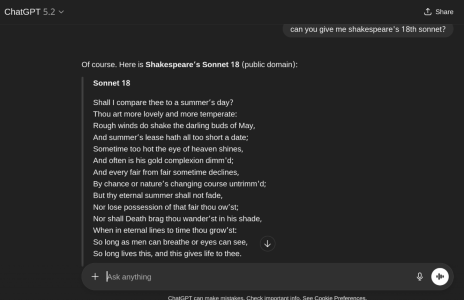
Here is how: Famous books and poems can exist in an AI's training data multiple times—the creators didn't cherry pick the data; they just grabbed whatever they could find. So super famous poems (like Shakespearean sonnets) were scanned during training multiple times. LLMs have "read" Shakespeare more times than any single person on earth.

And I shall repeat: How do LLMs generate text? By using the dataset to predict the next most likely word. Now. What do you think happens when an LLM is asked to write a Shakespearean poem? The AI is able to reproduce the whole thing word for word—even though the raw text no longer exists.

See for yourself:
1765580579600.png

So, in a way, training data do still exist within the LLM—just in the form of statistical connection. You can see how ChatGPT even reminds me that its in the public domain. This is because in its early days, people could get it to reproduce copyrighted material very easily, so OpenAI had to train it to refuse. It still can of course. It's just that OpenAI restricted it.

I am using all of this to say: It's not fair to compare the way a human learns versus an LLM does. No human can recite every single word of Shakespeare like ChatGPT can. That's why there is no real answer to what you asked me. It's not a matter of a number, but a matter of how LLMs are trained.

A human doesn't need to consume the entire Internet to write. ChatGPT does. Why? Because it isn't intelligent. It just predicts the next word. I'd even go as far as to say that it is the opposite of intelligence. A good student understands the topic they are taught and use their understanding to pass an exam. A bad student reads the textbook over and over, memorizing words and patterns, to pass the exam by memory.

This is all just my take, backed by science :)
 
This is all just my take, backed by science :)

Humans also choose the next word based on what knowledge they have acquired. The only difference is one of scale.

But even that is by the by. The point is, that without direction, the sheer scale of input means everything tends towards an average.

But if you tell it to produce a piece in the style of Shakespeare, it will - and it *is* possible for a single human to read all the works of Shakespeare. So when would that become unclean, vs a human trying to write like Shakespeare? So the question isn't moot.

However, again, I am not suggesting people use it to produce novels. And I still think there are perfectly legitimate uses for it to support the creative process.

And AI art enables people to produce images that they otherwise could not afford to do, or have the expertise to produce themselves. That's not necessarily a bad thing - just like the fact that Adobe Photoshop allows us to manipulate images in ways that required a lot more expertise and specialist equipment in the past.

And yes, I understand how LLMs work and what they do. Please don't assume that I don't. The argument, as far as I'm concerned, isn't about how the end result is arrived at. Most arguments around the merits and judgement on AI is driven by entirely unscientific emotions. Anyway, I'm done. I'll come back here when this thread moves on. No one agrees with me anyway.
 
Last edited:
Humans also choose the next word based on what knowledge they have acquired. The only difference is one of scale.
I'm not sure what you are trying to claim here. Are you saying that while humans need 10 times of material to learn, LLMs need 10000 times the material?

I guess that's true as a pure fact. But the way you are portraying it is extremely misleading. You say that this is the "only difference"? For starters, humans don't use statistics to predict the next most likely word. The way we form sentences is completely different. We're nothing like LLMs. An LLM is simply a very highly advanced algorithm. That is all it is.

The human brain is a big unknown, especially consciousness. Based on this fact alone, it's basically impossible to compare an LLM to a human brain. But in any case, I'd rather not discuss this. I don't want this to descend into an argument. Because that's what will happen.
 
Also, could the mods move the AI posts in a dedicated thread? This one got clogged up and the actual related posts kinda get hidden as a result of the big discussion. I feel bad about kind of causing that.
 
Well, one would certainly hope humans can product stuff that is better than AI can. As we've seen on this thread, people still value that.
My point is that is makes it harder for normal organic artists to make it when people are using AI for their artificial creations.

Also, people have to consider that AI has made leaps and bounds in just a few years. Where before it could barely make a passible human impression, now AI images are nearly unrecognizable from real photography. In just a short time, it will be making art that looks realer than it did a few months ago even.
 
Last edited:
Thanks @ps102 for your detailed breakdowns. I think these discussions are still worth having as it feels like there's a chance to change minds with more information. A lot of the bizarre analogies I come across justifying its use quickly fall apart under basic scrutiny and a bit more knowledge.
 
Back
Top