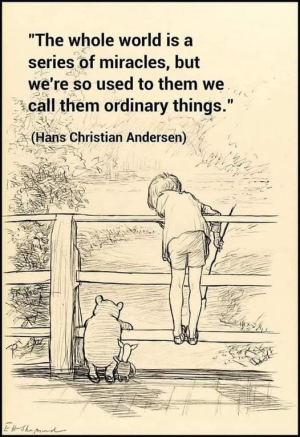
Everyday magic

GrahamLewis

Active Member
Member
New Member
I'm thinking of things that we tend to take for granted, or explain away, but are still wonderful upon further consideration. Like compost -- there's something mystical about taking vegetable scraps, coffee grounds, banana and orange peels, tossing them in a big black tub and closing the lid; a few months later, rich brown and fertile soil.

Every time.
 
Trees. Their roots dig down into the earth, connecting them to it in a way that we never could be. I have always found a sort of magical beauty in that.

Babies learning how to speak, by the simple act of us speaking to them.

The wind. It carries things, smell of cologne, bubble gum, fire, etc...and in doing so it acts as an unseen messenger
 
Anything we don't understand becomes magic. It stops being magic when we learn that extra fact.

Take the light switch. To us, it's a simple, utilitarian, everyday convenience. But how many of us know (or care to learn) how it works?

When I was a toddler, personal home computers were in their infancy. No-one could have imagined the internet back then.

I remember reading The 35th of May by Erich Kästner (published 1932), in which a man pulls a rotary phone from his pocket and calls his wife. It was purest fantasy back then, of course ... but not now. But how many of us know how they work? Or want to know?
 
Anything we don't understand becomes magic. It stops being magic when we learn that extra fact.

Magic is enhanced by knowledge, not devalued. I grew up in south Texas. Seeing water freeze outside for the first time changed my life and put me on the road to becoming a scientist. Understanding the process of freezing has not reduced the magic; the phenomenon is as wonderful to me at 70 as it was at 7.

Of course, at 70, I don't like driving on the damn stuff. ;)

A couple of winters ago, we had temps of negative 35 F for much longer than usual (no, I don't live in south Texas anymore). I'd hate to tell you how much time I spent boiling water and throwing it into the air to watch it go POOF! Magic.
 
"In normal conversation we speak at a rate of about 300 syllables a minute. To do this we force air up through the larynx . . . and, by variously pursing our lips and flapping our tongue around in our mouth rather in the manner of a freshly landed fish, we shape each passing puff of air into a series of loosely differentiated plosives, fricatives, gutturals, and other minor atmospheric disturbances. These emerge as a more or less continuous blur of sound. . . . Syllables, words, sentences run together like a watercolor left in the rain. To understand what anyone is saying to us we must separate these noises into words and words into sentences so that we might in our turn issue a stream of mixed sounds in response . . . . And yet we achieve the process effortlessly." Bill Bryson, The Mother Tongue (Avon 1990) p. 90.

Enough said.
 
A couple of winters ago, we had temps of negative 35 F for much longer than usual (no, I don't live in south Texas anymore). I'd hate to tell you how much time I spent boiling water and throwing it into the air to watch it go POOF! Magic.
We've done that so many titimes. It's great entertainment!
 
I've always thought it magnificently wondrous that we can detect our environment - in the form of stimuli, like chemicals, light, pressure - be aware of what is not us - and from all that is detected, we construct a reality.

Related to that is our ability to "see." We don't really see what is around us. All matter is made of globs and blobs and shapes and arrangements of atoms and molecules, and atoms and molecules are colourless, invisible things, in the absence of light. What we really detect/see is the light reflected by everything.
 
"What are our phones and tablets, our social-media platforms, if not technically sweet? They are so sleek and sophisticated technologically, with their invisible code and awesome computing power, that they have become, as Arthur C. Clarke once wrote, indistinguishable from magic." Noah Hawley, "Vonnegut and the Bomb," Atlantic Magazine, August 2025
 
"What are our phones and tablets, our social-media platforms, if not technically sweet? They are so sleek and sophisticated technologically, with their invisible code and awesome computing power, that they have become, as Arthur C. Clarke once wrote, indistinguishable from magic." Noah Hawley, "Vonnegut and the Bomb," Atlantic Magazine, August 2025

There's another article put out by the Atlantic this month with the title

The Making of Kurt Vonnegut’s Cat's Cradle

that also refers to the information age, in this way:

In some ways, Little Boy was the ultimate invention of the Industrial Age, which ended a few years later. What replaced it? The Atomic Age, of course, followed in the 1970s by the Information Age. Were Vonnegut alive today, he might say that whatever they call the age you live in is actually the name of the weapon they’re using to try to kill you.
 
There's another article put out by the Atlantic this month with the title

The Making of Kurt Vonnegut’s Cat's Cradle

that also refers to the information age, in this way:

In some ways, Little Boy was the ultimate invention of the Industrial Age, which ended a few years later. What replaced it? The Atomic Age, of course, followed in the 1970s by the Information Age. Were Vonnegut alive today, he might say that whatever they call the age you live in is actually the name of the weapon they’re using to try to kill you.
Same article.
 
Back
Top