Interesting Etymologies

I was thinking today about the connection between the words lunar and lunacy. The idea is that the moon has some power over our behavior. Werewolves, take note! But is it a good thing or a bad thing to be moonstruck?
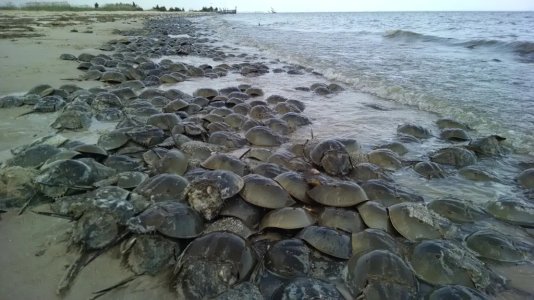
Well, it governs the mating habits of many species, which makes sense considering it's the only primordial monthly clock in existence. If you haven't seen 9 zillion horseshoe crabs engaged in orgy at a high tide full moon in early summer, you haven't lived yet. I'm serious. They'll line the whole coastline in waist deep piles.

1753139537720.jpeg
 
A whole new meaning to the term "mooning"
 
That's pretty tame. I've seen them in Salt Pond stacked over the surface in 3 feet of water thrashing like a bunch of heathens. Fascinating creatures. They haven't evolved at all in like half a billion years or something.
 
That's pretty tame. I've seen them in Salt Pond stacked over the surface in 3 feet of water thrashing like a bunch of heathens. Fascinating creatures. They haven't evolved at all in like half a billion years or something.

Their eggs are eaten in Thailand.
 
I was thinking today about the connection between the words lunar and lunacy. The idea is that the moon has some power over our behavior. Werewolves, take note! But is it a good thing or a bad thing to be moonstruck?

I'm pretty sure that belief had existed for a long time, and still does. In the Middle Ages, people believed that the position of the planets and stars when they were born meant what kind of person they would be.

We still believe in a similar thing now. We just call it the astrology column in the papers.

And some people still believe in it -- and fervently -- otherwise they wouldn't talk about getting vibes from the grocery store because Mercury is in retrograde, and so on.
 
But full moons sort of make us more romantic?
 
The word clue has an interesting origin.

Defined since the 16th century as “anything that guides or directs in an intricate case” – it derives from the Germanic word clew – which is a “ball of thread or yarn.” Is it about finding the end of the thread?

This is not the only word that transformed from an -ew ending to an -ue ending. Others include blew (blue) and imbew (imbue), representing a change from the Old German to Old French.

Also, in the 18th century, they said "shew" for "show"
 
Yep, I've heard of "clew" and "shew". (I'm fairly certain I've seen the word "shew" in Shakespeare at least once).

And then I wondered about the etymology (or at least the origin) of the name "Shakespeare". I'm sure we can all imagine what it means -- "to shake a spear" -- but a quick google and jump to Etymonline later informed me that the name is ...

Originating from late Old English, the surname recorded from 1248 means "a spearman," derived from "to shake" meaning to brandish or flourish a weapon.

This was a common type of English surname (e.g. Shakelance (1275), Shakeshaft (1332), etc.) and was in use through Middle English. Compare also shake-buckler "a swaggerer, a bully;" shake-rag "ragged fellow, tatterdemalion," an old name for a beggar.

Now I wonder if shake-bowl (referring to the bowls beggars would thrust at passers-by to demand alms) was also in use, or if shake-rag was also used for Morris dancers.
 
Something I read on Reddit today:

The word “oxymoron” is an oxymoron itself. Oxus is the Greek word for “sharp” and moros is Greek word for “dull”
 
  • Like
Reactions: JLT
May I refer you to a book by Robert Claiborne: Loose Cannons and Red Herrings: a book of lost metaphors. He traces the surprising origins of dozens of common words. (Example: "daisy" comes from "day's eye"). Well worth getting a copy of, to place beside his masterpiece Our Marvelous Native Tongue: The Life and Times of the English Language which is indispensable reading for anybody who loves the language.

As for me, a left-handed person, I resent being called gauche or sinister, whereas right-handed people are adroit.
 
Does anybody remember Ed Sullivan referring to his variety show as a "really big shew"?

I am old enough to have watched Ed Sullivan!
 
The definition of the word "seedy" has somewhat changed over the last couple of centuries.

Two hundred years ago it was used to mean worn-out, poverty-stricken, used-up, shabby - like a plant gone to seed.

From 1835:

“Oh, let my hat be e’er sae brown,
My coat be e’er sae SEEDY, O!
My whole turn-out scarce worth a crown,
Like gents well-bred, but needy, O!”

Fisher’s Garland for 1835.

Sometime since then it took on the definition of disreputable.
 
  • Like
Reactions: JLT
The definition of the word "seedy" has somewhat changed over the last couple of centuries.

Two hundred years ago it was used to mean worn-out, poverty-stricken, used-up, shabby - like a plant gone to seed.

From 1835:

“Oh, let my hat be e’er sae brown,
My coat be e’er sae SEEDY, O!
My whole turn-out scarce worth a crown,
Like gents well-bred, but needy, O!”

Fisher’s Garland for 1835.

Sometime since then it took on the definition of disreputable.
I thought "gone to seed" referred to a lawn or garden that had been neglected, a reflection on the gardener who wasn't diligent in their work. Such a person would gain a reputation for incompetence, I'd guess, and would not be a prospective hire.
 
I thought "gone to seed" referred to a lawn or garden that had been neglected, a reflection on the gardener who wasn't diligent in their work. Such a person would gain a reputation for incompetence, I'd guess, and would not be a prospective hire.

This may be the connection between the older and the newer definition
 
I thought "gone to seed" referred to a lawn or garden that had been neglected, a reflection on the gardener who wasn't diligent in their work. Such a person would gain a reputation for incompetence, I'd guess, and would not be a prospective hire.

This may be the connection between the older and the newer definition
As I remember it...
When I was a kid, my father grew about an acre of potatoes (what else?) in the plot around the house, which we picked when in seaon, to be turned into chips (French fries) at the joint where my mother applied discretionary payment options to the daily truck of schoolkids. When the business went kaput, for reasons not entirely divorced from the discretionary payment schedule, the last crop was picked, packed under covering and left in the field where they "went to seed" as I recall it being said, meaning spoiled for consumption as they began to sprout new growth.
 
Cockneys use rhyming slang in everyday speech.

Examples:
Apples and Pears = Stairs
Porky Pie = Lie
Dog and Bone = Phone
Khyber Pass = Arse

The list goes on and on.
Proper cockneys should only use the first half in rhyming slang... someone using the whole couplet is the signof a mockney. 'a'ight me old china, had a terrible ruby last night, got brace running out of my khyber, not good on the chalfonts'

china plate= mate
ruby murray = curry
Brace and bit = shit
kyhber pass = arse
Chalfont St Giles (a posh town in buckinghamshire) = Piles aka haemeroids
 
Barney = Barney Rubble = Trouble.
Donald = Donald Duck = ...ok, maybe not. I'm sure there's a genuine one though.
 
Back
Top