That's Awesome!

Louanne Learning

Active Member
Member
New Member
Role Play Moderator
Winner: 4th Contest August Winner: June Flash Fiction
I mean awesome in terms of its earliest definition – that which inspires a feeling of awe.

The word “awe” dates back to around the year 1300, and originally referred to "fear, terror, great reverence."

I’m not sure about the fear aspect, but the current understanding does include great admiration and veneration. Maybe some dread?

What inspires awe in you? It might be a thing, or an event, or a practice, or a person, or just something that happened to you this morning. Please share!

There are no wrong answers!
 
I’m awed by the fact that as living things we can be aware of what is “not us.” That we are able to detect information from the environment, using our senses, and then use our brain to construct a reality from that.
 
I am reminded of Einstein's quote:

“There are only two ways to live your life. One is as though nothing is a miracle. The other is as though everything is a miracle.”
 
Is there a relationship between awe and gratitude?
 
Awe includes fear, even in modern meaning. Do you remember "shock and awe" tactics in some recent wars?

That probably has its roots in a religious meaning. The greatest awe, after all, used to be reserved for God, who it was said we should fear.

But, if I consider what stirs up awe in me, it doesn't stir up fear with it.
 
But, if I consider what stirs up awe in me, it doesn't stir up fear with it.

So, then, thinking of the emotions that the recognition of this fact stirs up in me:

I’m awed by the fact that as living things we can be aware of what is “not us.” That we are able to detect information from the environment, using our senses, and then use our brain to construct a reality from that.

Fear? I don’t think so. (Fear of what?) Instead - a reverence for Nature, and what it has produced. A call to make the most of this precious life. I think I want to define awe by its positives, not by negatives. I belong to Nature, and it seems a rare privilege.
 
Interspecies friendships

I love watching the videos of dogs and cats that are best friends, always cuddling!

caretaking

My husband had MS (he died in 2021) and I was his caregiver before he died. It was incredibly demanding, but incredibly rewarding. It brought us so very close together, a connection I couldn't even put into words. It still amazes me all the lessons we learned from that.
 
My husband had MS (he died in 2021) and I was his caregiver before he died. It was incredibly demanding, but incredibly rewarding. It brought us so very close together, a connection I couldn't even put into words. It still amazes me all the lessons we learned from that.

Careheart.jpg
 
Awe includes fear, even in modern meaning. Do you remember "shock and awe" tactics in some recent wars?

Fear? I don’t think so. (Fear of what?) Instead - a reverence for Nature, and what it has produced. A call to make the most of this precious life. I think I want to define awe by its positives, not by negatives. I belong to Nature, and it seems a rare privilege.

My point is that it is still used in that context, that meaning hasn't disappeared.

Awe certainly does include fear. Remember the centuries' long relationship between human beings and otherworldly creatures, like elves or trolls.

For centuries, elves were treated with awe and fear (especially in Celtic and English folklore). Blacksmiths were valued in rural communities, because they could shape iron, which was the only thing that could stop elves. Elves could lead you astray in the woods (especially if you drank too much). They could make you forget, and even lose track of time. They stole babies, and replaced them with changelings. They made the milk go sour, or a normally docile cow kick you. (Yes, we know that's not the real cause, but let's think ... mythologically).

Words like 'awe' have power. Elves can awesome (i.e. full of awe) or awful (also "full of awe"). Elves are also terrific -- or terrible: they beget terror.

It got so that you couldn't even say the word "elf". Instead, folk said "the lordly ones", "the shining ones", and spat and touched iron for good luck.

Then Shakespeare came along and made elves into tiny, cute creatures, and gave them names like Peaseblossom. Mab, his Queen of the Elves, was fearsome, but once she reunited with her King, everything ended happily.

Tolkien made elves tall, handsome and wise -- but he also made them terrific warriors, whom you would be unwise to cross.

Of course, nobody nowadays believes in elves or sprites or dobbins, especially not the way they used to. But the power of myth dies hard.
 
Tolkien made elves tall, handsome and wise -- but he also made them terrific warriors, whom you would be unwise to cross.
Now everybody wants to be an elf, at least aesthetically. Common roleplay choice for escapism. It doesn't seem to go beyond slight pretty person with long ears that lives a long time. I've always found that boring.

It's similar to vampires. Take away their faults and weaknesses, then they're no fun.

Oh, now that I think about it, orcs were generally softened as well.

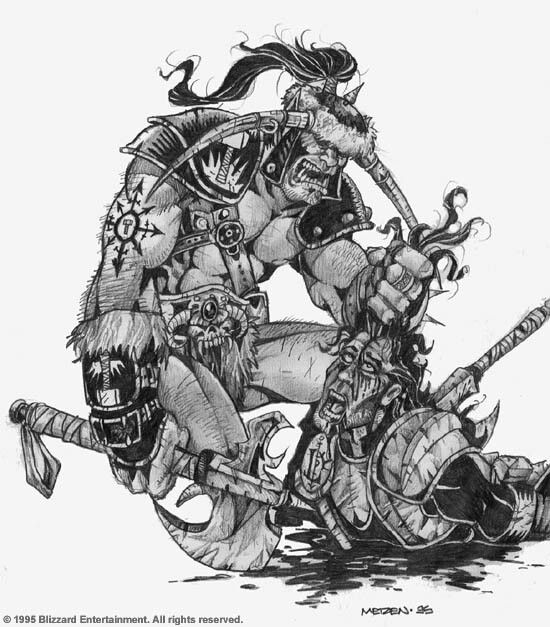
On the topic of awe-inspiring, that rough 80s-2000s fantasy art turned a lot of people into nerds. Early DnD, Warcraft 1 and 2, etc. This is art from Warcraft 2. I recall someone said of it "It's like I'm peering into a world I'm not supposed to."
5cf1bf267c723dcbb78603b14892c8e5.jpg
 
the power of myth

One of the great powers of myth is that they capture human archetypes

Here's something I got in my inbox yesterday from Dr. Sharon Blackie -

Let’s begin by reminding ourselves that myths are archetypal stories, sort of by definition, and the key players in them are also archetypal. This means that we can’t map the essential archetypal qualities of the feminine and the masculine which these characters represent directly onto the lived experience of actual human men and women. They don’t map. That’s because archetypes are essential qualities: they’re essences. They’re in a sense extremes. They represent a ‘pure’ idea or image which doesn’t actually exist in the physical world. Actual human men and women can’t ever reflect pure archetypes. Rather, we’re reflections of a combination of different archetypal energies that might be at work in our lives at different times. We can never be the archetypal Witch, but we might just let a bit of Witch energy into our lives from time to time – maybe mixed up with a bit of the energy of the Maiden archetype and also a bit of the Warrior.

The archetypal feminine and the archetypal masculine – what do the concepts actually mean?

 
Back
Top