It better get a few to protect itself before I kick its teeth in. If I have to deal with one more AI chatbot today there's going to be a bit of the ultra-violence.It will need AI buddies at that point
That's interesting and likely accurate.It will need AI buddies at that point, because humans won't be able to relate to its experience nor the art that stems from it. How lonely.
an illustration of violence, cruelty, brutality ... These things are part of the human condition (humanness?)
I have been thinking about this--why would meaningful AI art look like meaningful human art? Everything we have told them, every data point is just ones and zeros in the end. Wouldn't it be nonsensical to us and only decipherably by them? People might call AI generations art, yet it is bound by harsh rules and taboo for maximum human appeal.It will need AI buddies at that point, because humans won't be able to relate to its experience nor the art that stems from it. How lonely.
We draw upon our experience for art, would they we must different?
golly I did not see my typos. It's fixed.Well, I would counter this by saying that human experience - and expression - is profoundly different from that of a machine.
Well pondering that experience and its relation to human experience is already pretty popular in fiction because of how many directions it can go and what it means.I have been thinking about this--why would meaningful AI art look like meaningful human art? Everything we have told them, every data point is just ones and zeros in the end. Wouldn't it be nonsensical to us and only decipherably by them? People might call AI generations art, yet it is bound by harsh rules and taboo for maximum human appeal.
that intelligence cannot exist without a sense of self
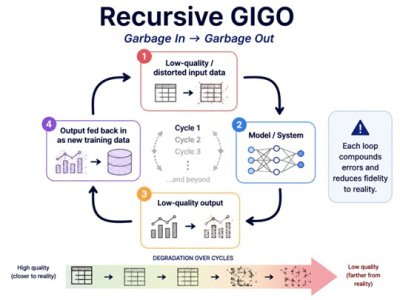
Not really surprising when you consider that this technology is essentially just output based on mathematical prediction. It's virtually impossible for these models to generate anything that is "novel", even if it looks like they are. Varied data is important for training.The human-generated data available to train LLMs is not unlimited – so the AI industry has embraced the appearance of growth by using synthetic data – using the output of chatbots to train new chatbots – leading to model collapse – a state where they output nonsense. Garbage in, garbage out = GIGO … when GIGO is recursive, it ultimately generates a pile of near-random bits.
Yeah. Instead of LLMs I was more talking about a hypothetical actual AI, which for all we know will never come to being.And this is the advantage humans have over machines. We have personhood - with all it entails - and that personhood develops through our participation in social groups. . We are “conscious agents (as subjects) within the forms of sociality”
Indeed, when AI participates with itself, it leads to something called model collapse. The AI industry has been marketing the promise of near-infinite growth to its investors and customers, but this is a myth.
The human-generated data available to train LLMs is not unlimited – so the AI industry has embraced the appearance of growth by using synthetic data – using the output of chatbots to train new chatbots – leading to model collapse – a state where they output nonsense. Garbage in, garbage out = GIGO … when GIGO is recursive, it ultimately generates a pile of near-random bits.
View attachment 1219
The research supports this idea -
AI models collapse when trained on recursively generated data
Here’s an interesting video explaining why this is true –
We use that term constantly in accounting reconciliation. Everything is garbage.Seeing the reference to GIGO made me smile. While most people know that it means "Garbage In, Garbage Out" some people in tech wryly call it "Garbage in, Gospel Out."
For the artist who turns pain into pleasure....
“What is a poet? An unhappy man
Very interesting. This articulate a suspicion that I couldn't fully grasp. Synthetic information is like the telephone game. The longer it goes on the more inaccurate in becomes and the less it resembles the original information. Halucinations increase exponentially. Outliers are lost.And this is the advantage humans have over machines. We have personhood - with all it entails - and that personhood develops through our participation in social groups. . We are “conscious agents (as subjects) within the forms of sociality”
Indeed, when AI participates with itself, it leads to something called model collapse. The AI industry has been marketing the promise of near-infinite growth to its investors and customers, but this is a myth.
The human-generated data available to train LLMs is not unlimited – so the AI industry has embraced the appearance of growth by using synthetic data – using the output of chatbots to train new chatbots – leading to model collapse – a state where they output nonsense. Garbage in, garbage out = GIGO … when GIGO is recursive, it ultimately generates a pile of near-random bits.
View attachment 1219
The research supports this idea -
AI models collapse when trained on recursively generated data
Here’s an interesting video explaining why this is true –
Interesting article – thanks for sharing.And this is the advantage humans have over machines. We have personhood - with all it entails - and that personhood develops through our participation in social groups. . We are “conscious agents (as subjects) within the forms of sociality”
I think these trends erode our creative faculties.
yes, when we give over human capacities to machines - those human capacities atrophy.
Artificial intelligence could significantly diminish humanity, even if machines never ascend to superintelligence, by sapping the ability of human beings to do human things…
People placing all their emotional dependencies on chatbots, and all the fun outcomes that follow, isn't new either.There's a fascinating article on AI and writing in the latest New Yorker magazine, writtten ( presume without AI assistance) by Dr. Jill Lepore, one of my favorite historians. She points out that AI "slop" has been around since the middle of the last century.