The General Writing Advice Thread!

That quote has been variously misattributed to Dostoyevsky, Tolstoy, Mary Morris, David Long, Hemingway, and Deepak Chopra, but these are all wrong. There is no evidence any of them ever said that.

The true source is John Gardner.

Thank you, Rath. Now I know.
 
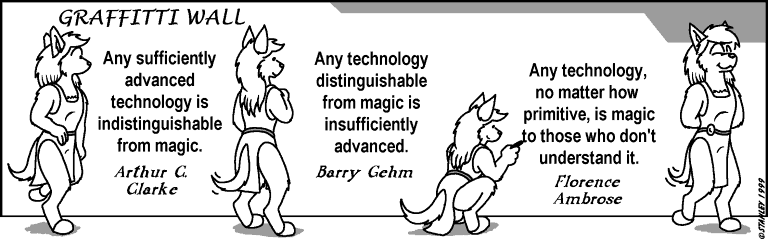
From Freefall, one of my favourite long-running* sci-fi webcomics:


fv00255.gif


______________________________
* How long-running, you ask? Since at least 1998. Woof. I feel old.
 
* How long-running, you ask? Since at least 1998. Woof. I feel old.

I still love Blondie. It first appeared in 1930, 25 years before my own grand entrance into the world of comedy and error. Talk about the fine art of adapting to changing times and audiences...
 
I refer to LaTorre's Law of Ascription:
"Any sufficiently pithy remark about human nature will eventually be ascribed to Mark Twain or Oscar Wilde."

LaTorre should have included GBS.
 
I've seen this advice to writers more than once in this, and other, writing forums - "The only rule is to be interesting."

Kurt Vonnegut put a similar sentiment at the top of his list of 8 Basics of Creative Writing:

Use the time of a total stranger in such a way that he or she will not feel the time was wasted.
 
Last edited:
Kurt Vonnegut put a similar sentiment at the top of his list of 8 Basics of Creative Writing:
I didn't realise that the gem in #7 is also from him. I wrote that one all in bold and big writing in a notebook once.

7. Write to please just one person. If you open a window and make love to the world, so to speak, your story will get pneumonia.
 
I really like the second piece of advice, too:

Give the reader at least one character he or she can root for.

I've seen the opinion that some people don't think it's important for readers to care about the characters, but I think it is.
 
I didn't realise that the gem in #7 is also from him. I wrote that one all in bold and big writing in a notebook once.

7. Write to please just one person. If you open a window and make love to the world, so to speak, your story will get pneumonia.
Which prompts me to ask you all: Who is that person that you write for?

Elsewhere, Vonnegut said that the person he wrote for was his sister Edith, even after she passed away.

The person I think I write for was my father. He was the quintessential avid reader, usually on the order of three books a week. I remember him coming across something I wrote on the London Bridge, and he told me that it was a fine piece of writing. I felt better about that than any other compliment I've received.

That piece, in another form, can be found here if you're interested:


(Subsequent research suggests that the Romans actually built a wooden bridge during their occupation of England, but the rest of the piece still holds up.)
 
Which prompts me to ask you all: Who is that person that you write for?

I don't have anyone in particular in mind. Does that mean I am writing for myself?
 
  • Like
Reactions: JLT
Write it and they will come.

Hmm. That sounds a tad risque, even though I don't write much erotica.

I should grab a chance to shut up now.
 
I don't have anyone in particular in mind. Does that mean I am writing for myself?


Right now it’s just me. I’m tired of not finding the book I want to read anywhere. So if anyone else is looking for that book, I’m writing it for them too.

Well, that's what Toni Morrison said. “If there's a book that you want to read, but it hasn't been written yet, then you must write it.” Great truth there.

But I think that Vonnegut was referring not to the writer, but the reader, the person whose opinion you value. You ask yourself "What would this person say about this writing? Would it meet what they consider my standards to be?"
 
But I think that Vonnegut was referring not to the writer, but the reader, the person whose opinion you value. You ask yourself "What would this person say about this writing? Would it meet what they consider my standards to be?"
Yes, I see the difference. I’ve been thinking about it. I just can’t think of a specific person — not that that reader doesn’t exist, but just that I haven’t met them yet. I want to write literary science fiction. Most people who enjoy literary works don’t bother with sci-fi, and most sci-fi fans aren’t interested in the literary side. At least, that’s how it is among the readers I know.
 
Write it and they will come.

Hmm. That sounds a tad risque, even though I don't write much erotica.

Which brings me to Vonnegut's rule #3: "Every character should want something, even if it is only a glass of water."

That's why writing erotica is so tempting. Everybody wants sex, or at least the expectation of sex. I don't think an erotic word has ever been written about people who aren't interested in sex in some form or other.

More often than not, it seems to be bad writing, but the subject draws bad writers like moths to a flame. There was a time when I read erotica after the internet made that free of charge, but gave up after my twentieth encounter with characters with 48DD busts or 13" penises (sometimes on the same character).

Another subject that draws writers like moths to a flame is science-fiction/fantasy, as we all know, but there's a correlation there. Vonnegut explained why Kilgore Trout's stories ended up in pornographic publications: what his stories and the rest of the book's content had in common was "not sex, but visions of impossibly hospitable worlds."
 
There’s one piece of advice to the writer that we haven’t touched on yet in this thread: Read, read, read!

In that vein, I thought I’d pass along some interesting information I read in The Culturist this morning, about philosopher Mortimer Adler’s (the author of How to Read a Book) approach to reading.

Adler described four stages of reading - beginning at the first level with elementary reading (recognizing words, sentences, and their literal meanings) then advancing to inspectional reading (reading quickly but with purpose), then to analytical reading (slow, deliberate effort to grasp a book in its entirety), and then the highest form of reading - syntopical reading.

With syntopical reading, the reader engages with multiple books on the same subject, compares ideas, and forms independent judgment - building your own framework rather than adopting someone else’s.

It’s moving from the study of a book to the study of a question.

I looked up some quotes from the book:

“In the case of good books, the point is not to see how many of them you can get through, but rather how many can get through to you.”

“Reading is a basic tool in the living of a good life.”

“....a good book can teach you about the world and about yourself. You learn more than how to read better; you also learn more about life. You become wiser. Not just more knowledgeable - books that provide nothing but information can produce that result. But wiser, in the sense that you are more deeply aware of the great and enduring truths of human life.”
 
Back
Top