
I'm reopening this thread. Please treat each other respect, and if you don't have anything new or informative to contribute, please refrain from responding.


I had the same experience when my local art museum hosted a show of Norman Rockwell paintings. Of course, I'd seen most of them in reproductions, including some of the stuff he did for the Saturday Evening Post when my mother subscribed to it. But when I saw the originals, I was flabbergasted by the way he used color and texture to create the impression of depth, things that were not transferred in the reproductions. I have the same feelings for Jerald Silva's work, which I've seen in reproductions and in his original art. The reproductions simply don't do justice to the originals. They are Beethoven's Fifth Symphony as performed by a string quartet of instruments not quite in tune.About 1977, I went to the Norton Simon Museum in Pasadena, CA because I wanted to see an exhibit of Degas' pastels. On my way, I passed a gallery of Picasso's work and casually glanced inside. A huge abstract painting at the end of the gallery caught my attention and pulled me in like a fish on a line. I spent about three hours in there, looking at drawings and paintings and who knows what. Changed my creative life. Ten minutes before the museum closed, I ran down to see the pastels. Yeah, they were pretty nice, but Picasso... I had NO idea.

 Winner: 4th Contest March
 Winner : February Poetry
 Winner: 4th Contest Feb
 Winner: 4th Contest August
 Winner: June Flash Fiction
use those tools to create something that did not exist before
Winner: 4th Contest March
Winner : February Poetry
Winner: 4th Contest Feb
Winner: 4th Contest August
Winner: June Flash Fiction
Winner: 4th Contest March
Winner : February Poetry
Winner: 4th Contest Feb
Winner: 4th Contest August
Winner: June Flash Fiction
 Winner: 4th Contest March
Winner : February Poetry
Winner: 4th Contest Feb
Winner: 4th Contest August
Winner: June Flash Fiction
Winner: 4th Contest March
Winner : February Poetry
Winner: 4th Contest Feb
Winner: 4th Contest August
Winner: June Flash Fiction
Gilgamesh
Winner: 4th Contest March
Winner : February Poetry
Winner: 4th Contest Feb
Winner: 4th Contest August
Winner: June Flash Fiction
Winner: 4th Contest March
Winner : February Poetry
Winner: 4th Contest Feb
Winner: 4th Contest August
Winner: June Flash Fiction

It kind of sounds like hustle culture?There is an urge or dynamic creative energy in life … which works towards wholeness and healing, towards building up and not pulling down … Our people, therefore, conceive human life as a force or power that continuously recreates itself and so is characterised by continuous change and growth which depends upon its own inner source of power … Since the essence of the ideal life is regarded as power and creativity, growth, creative work and increase have become essential values. Powerlessness or loss of vitality, unproductive living, and growthlessness become ultimate evils in our indigenous culture.
~ Ghanaian philosopher Noah Dzobo
Although Tutu, along with perhaps a majority of African philosophers, prizes social harmony, reflection on how to engage with others reveals something about how to engage with ourselves. Indeed, if we owe others friendly relations (say, because they have dignity), then we owe ourselves the same.
Harmony = friendliness feels like a sleight of hand here.These two characteristically African values of harmony (friendliness) and vitality (liveliness) constitute two accounts of what all duties to oneself have in common. Each independently explains much of the list of duties to oneself with plausibility. But is one account more promising than the other? Are duties to oneself prescriptions to harmonise with oneself or to enhance one’s vitality?
Winner: 4th Contest March
Winner : February Poetry
Winner: 4th Contest Feb
Winner: 4th Contest August
Winner: June Flash Fiction
I don't think it's an actualization failing if someone does not paint or write or sculpt.

More in the explanation than the food preparation, in my experience.Cooking is a great creative thing, too!
Doing it for a living will kill that notion in a hurry.Cooking is a great creative thing, too!
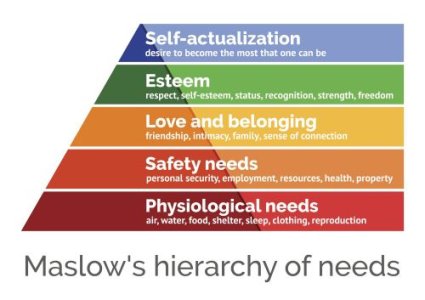
That accords nicely with something that Kurt Vonnegut wrote:First, it speaks to something in which I sincerely believe – that attaining self-actualization involves creative work.
Winner: 4th Contest March
Winner : February Poetry
Winner: 4th Contest Feb
Winner: 4th Contest August
Winner: June Flash Fiction


