The artistic experience

I'm reopening this thread. Please treat each other respect, and if you don't have anything new or informative to contribute, please refrain from responding.
 
Thanks, Homer. I regretted the closure of the thread, and am glad that it's back.

I had to go over and re-read all the entries to find out what I'd said before and what others have commented on. Before I go to my next comment, I'll review these:
About 1977, I went to the Norton Simon Museum in Pasadena, CA because I wanted to see an exhibit of Degas' pastels. On my way, I passed a gallery of Picasso's work and casually glanced inside. A huge abstract painting at the end of the gallery caught my attention and pulled me in like a fish on a line. I spent about three hours in there, looking at drawings and paintings and who knows what. Changed my creative life. Ten minutes before the museum closed, I ran down to see the pastels. Yeah, they were pretty nice, but Picasso... I had NO idea.
I had the same experience when my local art museum hosted a show of Norman Rockwell paintings. Of course, I'd seen most of them in reproductions, including some of the stuff he did for the Saturday Evening Post when my mother subscribed to it. But when I saw the originals, I was flabbergasted by the way he used color and texture to create the impression of depth, things that were not transferred in the reproductions. I have the same feelings for Jerald Silva's work, which I've seen in reproductions and in his original art. The reproductions simply don't do justice to the originals. They are Beethoven's Fifth Symphony as performed by a string quartet of instruments not quite in tune.

When this thread closed, I was about to give my opinion on whether writing is an art. Like any other endeavor, my art comes in when I examine what I've written, and critique it, and amend it. (And I should add that the writing often happens in the writer's head, before the pen or the keyboard is used.) Is it what I wanted to say? Does it invoke any impression of what I was feeling when I wrote it? Could it be improved? Is this something that I could encounter years later, when the piece is no longer fresh in my mind, and think: "Yes, this is something that still conveys what I wanted to say"?

In the process, I use the tools I have at hand: vocabulary, grammar, punctuation, and familiarity with the topic. I could use these tools well, or I could use them haphazardly. That is the difference between good art and bad art, no matter what the medium.

The tools largely define the art. The painter has the brush, the paint, the canvas, the easel, and the palette. The woodcarver has the wood, the knives, the chisels, and the stand. The singer has the voice, the choice of instrumental accompaniment, the studio's recording process. The songwriter has the words and the melody and, often, the choice of performer of the music. These are all things that distinguish good art from bad art.

And the artist's mission is to use those tools to create something that did not exist before the creation of the art. The Beatles gave up performing because they no longer felt obliged to be creative (or, in the concerts they gave, even heard). After a certain point, they felt that only in the studio could they advance their art, doing things that were impossible in a live concert setting.

One more thing: Art doesn't necessarily need an audience. I can write to perfection and then burn the manuscript. A singer can sing in an empty room. A woodcarver can toss the carving into the fire after he's finished with it. But in every case, the creation isn't random or unworthy of the effort. It sharpens the artist's skills and gives a sense of gratification for having done the art, and provokes the need to seek improvement. I played guitar for many years just to amuse myself before I ever made a practice of performing for others. It wasn't wasted effort.
 
There are two words that keep coming back to me, in the context of the artistic experience – trust and truth

Artists need to trust themselves to tell the truth. This is especially true for writers.

When you ask “what was it like for me?” – you’re diving into the invisible, and we gotta have faith in our invisible

It’s not mystical! It is entirely human.

Consider – when you were editing chapter one ten times – what were you adjusting?

Being an artist just means taking responsibility for your work.
 
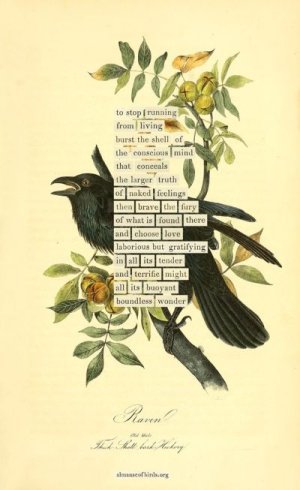
Below is a page out of An Almanac of Birds: 100 Divinations for Uncertain Days – which reads like a call to artists to their art.

Two take-aways from this “divination” –

Break free. Be as outlandish as you can. Do not censor yourself, especially on that first draft, but let your imagination run wild and follow it wherever it goes. F*ck the inner critic.

Love what you are doing. This is not only love for what you’re writing, but for the reader. Writing at heart is an act of sharing.

1772843353922.jpeg
 
  • Like
Reactions: JLT
A thought on art from Ralph Waldo Emerson that's got me thinking:

"Perpetual modernness is the measure of merit in every work of art."

I take it to mean that while art doesn't have to reflect our current time and place, it must work to put the reader or listener or observer into a place where what the artist produces seems modern, that the recipient can identify with and relate in some way to it as pertaining to them.

To test that theory, I picked up a translation of Gilgamesh, which actually predates the Bible. The culture it portrays is fundamentally different from our own, but after reading a few pages I could slip into that culture and see its point of view. So, in that sense, it's modern to me...it relates to my own time.
 
Gilgamesh

I've read it!

The oldest known poem - Epic of Gilgamesh, from ancient Mesopotamia, dating to the Third Dynasty of Ur, circa 2100 BCE.

Below is the first part of Tablet One (the beginning of a journey for Gilgamesh).

He who has seen everything, I will make known (?) to the lands.
I will teach (?) about him who experienced all things,
... alike,
Anu granted him the totality of knowledge of all.
He saw the Secret, discovered the Hidden,
he brought information of (the time) before the Flood.
He went on a distant journey, pushing himself to exhaustion,
but then was brought to peace.
He carved on a stone stela all of his toils,
and built the wall of Uruk-Haven,
the wall of the sacred Eanna Temple, the holy sanctuary.
Look at its wall which gleams like copper(?),
inspect its inner wall, the likes of which no one can equal!
Take hold of the threshold stone--it dates from ancient times!
Go close to the Eanna Temple, the residence of Ishtar,
such as no later king or man ever equaled!
Go up on the wall of Uruk and walk around,
examine its foundation, inspect its brickwork thoroughly.
Is not (even the core of) the brick structure made of kiln-fired brick,
and did not the Seven Sages themselves lay out its plans?
One league city, one league palm gardens, one league lowlands, the open area(?) of the Ishtar Temple,
three leagues and the open area(?) of Uruk it (the wall) encloses.
Find the copper tablet box,
open the ... of its lock of bronze,
undo the fastening of its secret opening.
Take and read out from the lapis lazuli tablet
how Gilgamesh went through every hardship.
 
  • Like
Reactions: JLT
Being a human is a very vulnerable proposition. I’m not sure any of us can go through our entire lives without asking, “What do they think of me?” But still, we put ourselves out there, especially in love, and hope that our acts of love will be appreciated.

The writer makes themselves vulnerable every time they share their work. It is a creation borne of them, a manifestation of personal identity creatively expressed.

It’s best done in love, not just for the writing, but for the reader. “Come, I want to draw you into this story.”

And when our act of love is appreciated, that means we have connected.

Elizabeth Bishop’s ode to time and love seems to fit here –

THE SHAMPOO
by Elizabeth Bishop

The still explosions on the rocks,
the lichens, grow
by spreading, gray, concentric shocks.
They have arranged
to meet the rings around the moon, although
within our memories they have not changed.

And since the heavens will attend
as long on us,
you’ve been, dear friend,
precipitate and pragmatical;
and look what happens. For Time is
nothing if not amenable.

The shooting stars in your black hair
in bright formation
are flocking where,
so straight, so soon?
— Come, let me wash it in this big tin basin,
battered and shiny like the moon.
 
  • Like
Reactions: JLT
In my inbox this morning, an interesting article from AeonA Duty to Oneself: African philosophical values of harmony and vitality have much to offer our thinking about what we owe to ourselves.

The article features the quote below from Ghanaian philosopher Noah Dzobo. I want to share it for a couple of different reasons.

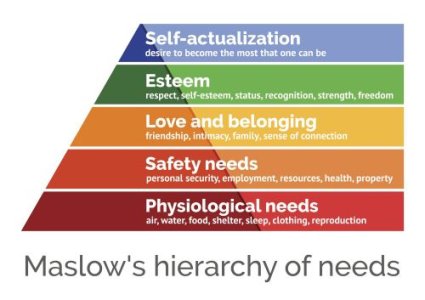
First, it speaks to something in which I sincerely believe – that attaining self-actualization involves creative work.

1773494458690.jpeg


Following the creative impulse broadens us beyond the mundane and the routine to get to the nitty-gritty of what we are. Lol, I just recalled a line from the novel I wrote ten years ago – “Live life full-ways, not half-ways.” When I see my nieces and nephews, I tend to ask them about whatever creative work they are involved in.

Second, this call to creative work transcends culture and time – the quote below comes from someone outside my particular heritage, but it immediately resonated with me, and I’m sure I’d find similar sentiments from the great 19th century Russian writers, to the ancient Greeks, to Bukowski (“Find what you love, and let it kill you”) to many others…

Here’s the quote -

There is an urge or dynamic creative energy in life … which works towards wholeness and healing, towards building up and not pulling down … Our people, therefore, conceive human life as a force or power that continuously recreates itself and so is characterised by continuous change and growth which depends upon its own inner source of power … Since the essence of the ideal life is regarded as power and creativity, growth, creative work and increase have become essential values. Powerlessness or loss of vitality, unproductive living, and growthlessness become ultimate evils in our indigenous culture.


~ Ghanaian philosopher Noah Dzobo
 
There is an urge or dynamic creative energy in life … which works towards wholeness and healing, towards building up and not pulling down … Our people, therefore, conceive human life as a force or power that continuously recreates itself and so is characterised by continuous change and growth which depends upon its own inner source of power … Since the essence of the ideal life is regarded as power and creativity, growth, creative work and increase have become essential values. Powerlessness or loss of vitality, unproductive living, and growthlessness become ultimate evils in our indigenous culture.


~ Ghanaian philosopher Noah Dzobo
It kind of sounds like hustle culture?

Although Tutu, along with perhaps a majority of African philosophers, prizes social harmony, reflection on how to engage with others reveals something about how to engage with ourselves. Indeed, if we owe others friendly relations (say, because they have dignity), then we owe ourselves the same.
These two characteristically African values of harmony (friendliness) and vitality (liveliness) constitute two accounts of what all duties to oneself have in common. Each independently explains much of the list of duties to oneself with plausibility. But is one account more promising than the other? Are duties to oneself prescriptions to harmonise with oneself or to enhance one’s vitality?
Harmony = friendliness feels like a sleight of hand here.

I think creativity and art are different enough concepts that it's worth mentioning. If someone works as a city planner, for example, I would argue that creativity is satisfied as a need. Of which, I'm inclined to agree seems universal enough. I don't think it's an actualization failing if someone does not paint or write or sculpt.
 
First, it speaks to something in which I sincerely believe – that attaining self-actualization involves creative work.
That accords nicely with something that Kurt Vonnegut wrote:

"If you want to really hurt your parents, and you don't have the nerve to be gay, the least you can do is go into the arts. I'm not kidding. The arts are not a way to make a living. They are a very human way of making life more bearable. Practicing an art, no matter how well or badly, is a way to make your soul grow, for heaven's sake. Sing in the shower. Dance to the radio. Tell stories. Write a poem to a friend, even a lousy poem. Do it as well as you possible can. You will get an enormous reward. You will have created something."

He also related something that an archeologist he was working with, while they were on a dig in the American Southwest, told him: “I don’t think being good at things is the point of doing them. I think you’ve got all these wonderful experiences with different skills, and that all teaches you things and makes you an interesting person, no matter how well you do them.”

There's a prestigious Order in the SCA whose members are those who have achieved some success and recognition in the arts. For reasons that escape me, I am a member of that Order. Whenever a new member is admitted to it, they usually hold a vigil the evening before, where other members counsel them on the expectations they will be obligated to fulfill... usually teaching and mentoring and such. But the advice I give is: "Become a beginner again. Find some art or science that you know little about, and learn about it the same way other novices learn, by taking classes and doing that new art. It is only by becoming a beginner that you realize what those you mentor are going through. And that is the easiest way of refilling your bowl of creativity when it begins to run dry."
 
Back
Top