The Philosophy Thread

I think all politicians should be philosophers. You can't get elected unless you have studied some of the greatest works of philosophy.

For example, I think all politicians should have read The Tao Teh King, or The Tao and its Characteristics, by Lao-Tse (circa 4th century BCE)

I love its emphasis on balance.

What philosopher do you think should be required reading for politicians? Why?
 
Dare I suggest Niccolo Machiavelli? :) I have read The Prince, and although Machiavelli's work has been derided as immoral, dangerous and controversial, he actually makes some very interesting points - for instance, on self-control:

Machiavelli emphasizes self-control not as emotional denial, but as a strategic tool for a leader to maintain power. He views emotional outbursts as weaknesses that can be exploited, so a prince must cultivate emotional discipline, appearing outwardly merciful, faithful, humane, honest, and religious while strategically acting as a lion (for strength) and a fox (for cunning) to adapt to circumstances and avoid being manipulated.

It advises rulers to prioritize political necessity and power over traditional morality, arguing that a leader must be willing to use unethical and even cruel means to maintain control. The book controversially separates politics from ethics, advocating for deception, treachery, and violence when deemed necessary for the state.

This led to it being seen as a handbook for tyrants, which made it was controversial at the time and still does today. But let me ask you four pertinent questions:

1. If The Prince had not been controversial, would it be memorable enough to last all this time?

2. Italy in Machiavelli's time was deeply divided, not only into regions like Tuscany vs. Calabria, but also into city-states ruled by warlords that constantly warred with each other, and made and broke alliances at the slightest whim. Doesn't that make these warlords into tyrants?

3. Can we, without being unfairly prejudicial, judge Machiavelli's work (or anyone else's work) by the standards of our own time? If so, doesn't that make us hypocrites?

4. Although many things have changed since The Prince was written, I'd say that many of Machiavelli's lessons -- a ruler's primary goal is to acquire and maintain power; leaders should be willing to use fraud, treachery, and violence; act based on how the world truly is, rather than how they wish it to be, etc. -- are still relevant today. Do you agree?
 
Dare I suggest Niccolo Machiavelli? :) I have read The Prince, and although Machiavelli's work has been derided as immoral, dangerous and controversial, he actually makes some very interesting points - for instance, on self-control:

Machiavelli emphasizes self-control not as emotional denial, but as a strategic tool for a leader to maintain power. He views emotional outbursts as weaknesses that can be exploited, so a prince must cultivate emotional discipline, appearing outwardly merciful, faithful, humane, honest, and religious while strategically acting as a lion (for strength) and a fox (for cunning) to adapt to circumstances and avoid being manipulated.

It advises rulers to prioritize political necessity and power over traditional morality, arguing that a leader must be willing to use unethical and even cruel means to maintain control. The book controversially separates politics from ethics, advocating for deception, treachery, and violence when deemed necessary for the state.

This led to it being seen as a handbook for tyrants, which made it was controversial at the time and still does today. But let me ask you four pertinent questions:

1. If The Prince had not been controversial, would it be memorable enough to last all this time?

2. Italy in Machiavelli's time was deeply divided, not only into regions like Tuscany vs. Calabria, but also into city-states ruled by warlords that constantly warred with each other, and made and broke alliances at the slightest whim. Doesn't that make these warlords into tyrants?

3. Can we, without being unfairly prejudicial, judge Machiavelli's work (or anyone else's work) by the standards of our own time? If so, doesn't that make us hypocrites?

4. Although many things have changed since The Prince was written, I'd say that many of Machiavelli's lessons -- a ruler's primary goal is to acquire and maintain power; leaders should be willing to use fraud, treachery, and violence; act based on how the world truly is, rather than how they wish it to be, etc. -- are still relevant today. Do you agree?

Well, this isn't what I had in mind when I posted - that the ruler should put his own interests above those of the citizens.

In fact, when the maintenance of power becomes the main goal, the common people generally suffer for it.

The Prince may be a piece of political philosophy, but I was thinking more of the philosophy that steers leaders to the greatest good for the greatest number of people.
 
Coming late to this discussion, but I have a few comments:

"... only morons fail to realise that it is only when you are broken that you can pick up the shattered fragments of you, to build the person you want to be."
I used that theory to recover from a nervous breakdown caused by the disintegration of my first marriage, which coincided with the disintegration of the marriage of some of my best friends. I cobbled it together from some of the stuff I'd been reading by Ouspenski and Gurdjieff. When I talked to my friends about my "psychic destruction," they were very concerned that I was going nuts. Well, I was, but that's another story.

In elementary school - I was I think in about grade 2 (about 7 years old) - the teacher drew a large oval shape on the blackboard. "This is your soul," she said. (Yes, I went to a Catholic school.)

Then she used the chalk to make some blotches on the soul. "This is sin on your soul," she said.

Then she used the blackboard eraser to wipe the sins off. "This is what happens when you are forgiven for your sins," she said.

Your teacher might have copped that from an essay in some Catholic magazine I read. (Yes, I was raised as a Catholic, too. It's amazing how many of my close friends turn out to be either practicing Catholics or "Catholics in recovery.") But the parable I read concerned nails being driven into a wall. Those were the sins. The pulling out of the nails represented absolution. But the spackling of the wall to conceal the holes was penance. I imagine that your teacher was reluctant to drive nails into the classroom walls, though.
Often, I feel like I do have a soul, especially in my connection with my husband who died. I still feel very connected to him. Clearly, physically, I am not. But what part of me feels so strongly that he is still with me?

Because he is now part of you, just as my first wife is part of me, even though she died thirty years ago. I think we are all the sum of the people and experiences we've known.
But, faith is not merely a word that can be defined. It is also a concept. A concept is something different from a definition.

An interesting take on that was offered by Margaret Atwood in an interview with Bill Moyers. When he asked her to define her religious views, she replied that, like Thomas Huxley, she was an agnostic. That is the only philosophically tenable view to take, she said, because science can neither design an experiment that proves that God exists nor design an experiment that proves that God did not exist. That made sense to me. I myself am a Bokononist, since I believe that "organized" religion is mostly a collection of comforting lies.
Faith as a concept covers a much broader scope - it encompasses things like trust, confidence, and hope.

But it can be taken too far if faith prohibits skepticism. I quote Kurt Vonnegut: "Say what you will about the sweet miracle of unquestioning faith, I consider a capacity for it terrifying and absolutely vile."
Got me thinking about the concept of certainty in not only philosophy, but science, too, and the relationship of certainty to the likelihood of acting on what you believe, or what you know.
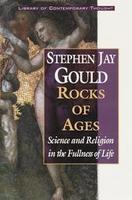
May I direct your attention to Stephen Jay Gould's book Rocks of Ages.


It argues that science and faith are compatible when seen as two aspects or "magisteria" (now there's a Catholic word for you), which address two views of the human condition, one describing morality and one describing the natural world.

It must be said that Richard Dawkins took exception to much of Gould's thesis, since he refutes religion utterly.
Why are we here?

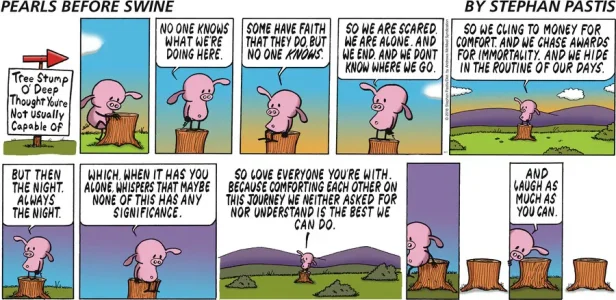
To quote another Vonnegut, Kurt's son Mark: “We're here to get each other through this thing, whatever it is.”

Or as Stephan Pastis put it so sweetly in his comic strip Pearls Before Swine:

pearls before swine on life.webp
 
I used that theory to recover from a nervous breakdown caused by the disintegration of my first marriage, which coincided with the disintegration of the marriage of some of my best friends. I cobbled it together from some of the stuff I'd been reading by Ouspenski and Gurdjieff. When I talked to my friends about my "psychic destruction," they were very concerned that I was going nuts. Well, I was, but that's another story.

I'm not sure why, but I have always had a little bit of an aversion to calling people "broken." I don't think we are ever broken, but rather, there are parts of us yet that we still need to discover. And those parts will bring us to a better place.

But the parable I read concerned nails being driven into a wall. Those were the sins. The pulling out of the nails represented absolution. But the spackling of the wall to conceal the holes was penance.

Ouch. The question that comes to my mind is - who was driving the nails into your soul?

Because he is now part of you, just as my first wife is part of me,

It really feels that way. But, at the same time, it really feels like a literal piece of me is missing. It's so hard to describe. He's here, but he's not here. My body was changed by his death.

she was an agnostic. That is the only philosophically tenable view to take, she said, because science can neither design an experiment that proves that God exists nor design an experiment that proves that God did not exist. That made sense to me. I myself am a Bokononist, since I believe that "organized" religion is mostly a collection of comforting lies.

I guess I am an agnostic, too. I would never be so arrogant as to imagine that the sum-total of what I can detect with my limited senses makes up all that might exist. The only reasonable answer to "Does God exist?" is "I don't know."

Of course, organized religion has turned out to be something very different from spirituality, or from the wisdom of some spiritual masters.

I came across a quote of Jesus' today, and thought it was pretty cool. Jesus said, “You will know them by their fruits.” (Matthew 7:16)

Seems to apply to some of the antics and spectacle put on by some politicians.

But it can be taken too far if faith prohibits skepticism. I quote Kurt Vonnegut: "Say what you will about the sweet miracle of unquestioning faith, I consider a capacity for it terrifying and absolutely vile."

I'm way too analytical and science-y to ever give up my skepticism. :sneaky:

It argues that science and faith are compatible when seen as two aspects or "magisteria" (now there's a Catholic word for you), which address two views of the human condition, one describing morality and one describing the natural world.

But, our morality comes out of the natural world. My morality came out of my evolution as a social animal. Morality is embedded in our biology. As social animals, the more we contributed to the group, the more we belonged to the group, the more we built meaningful relationships, the greater was the survival of the group.

The scientific theory used to support this truism of who we are - the Theory of Inclusive Fitness – states that an organism’s genetic success is believed to be derived from cooperation and altruistic behavior.

Think about it. Most of our morality is related to how we treat others. We are genetically programmed to be members of a group.

“We're here to get each other through this thing, whatever it is.”

Yes! We are social animals! And our primary motivator is human connection.
 
This morning, I began reading Nietzsche’s Will to Power, (read online for free at the link).

The translator, in his preface, comments about Nietzsche’s ideas of truth:

With the question of Truth we find Nietzsche quite as ready to uphold his thesis as with all other questions. He frankly declares that "the criterion of truth lies in the enhancement of the feeling of power" …

Nietzsche proceeds to argue that what provokes the strongest sentiments in ourselves is also true to us, and, from the standpoint of thought, "that which gives thought the greatest sensation of strength"…

The provocation of intense emotion, and therefore the provocation of that state in which the body is above the normal in power, thus becomes the index to truth…

Sounds like he is talking about subjective truth (and then – personal power?)

I suppose “power” is another one of those words – like “reality” and “truth” - open to various interpretations.

In Part One (The Will to Power in Science) – Nietzsche writes:

We had the whole pathos of mankind against us,—our notion of what "truth" ought to be, of what the service of truth ought to be…

Which suggests the collective.

Anyway, I find that an interesting question: What ought the service of truth be?
 
I suppose “power” is another one of those words – like “reality” and “truth” - open to various interpretations.
Especially since he wasn't writing in English. Think of all the nuances for the synonyms for "power"...strength, force, influence and so on... and you have to wonder why the translator chose that particular word. "Kraft" in German can mean any of those things (and I'm guessing that "Kraft" was the word Nietzsche used).
 
I'm not sure why, but I have always had a little bit of an aversion to calling people "broken." I don't think we are ever broken, but rather, there are parts of us yet that we still need to discover. And those parts will bring us to a better place.

Just because we're "broken" doesn't mean that we can't be glued back together, sometimes with higher-quality pieces that weren't available before. The seams will probably show, though. I've heard that scars are just tattoos with more interesting stories to tell.

Ouch. The question that comes to my mind is - who was driving the nails into your soul?
The answer: we are the ones who drive the nails in for our sins. Those are the only things we have to confess, in this analogy. Of course, sometimes events come from outside that damage our wall, but we aren't responsible for those.
It really feels that way. But, at the same time, it really feels like a literal piece of me is missing. It's so hard to describe. He's here, but he's not here. My body was changed by his death.
I hear you.
I came across a quote of Jesus' today, and thought it was pretty cool. Jesus said, “You will know them by their fruits.” (Matthew 7:16)
One of my favorite quotes from the New Testament. As a woodworker, I can relate to that. Some wood is good for building or for crafting or producing tasty food, while other wood is basically just good for firewood.

The catch is that sometimes you don't know whether the tree will bear good fruit or bad fruit until the fruit is harvested. So it is with people, which is why you have to cut other people a little slack from time to time.
But, our morality comes out of the natural world. My morality came out of my evolution as a social animal. Morality is embedded in our biology. As social animals, the more we contributed to the group, the more we belonged to the group, the more we built meaningful relationships, the greater was the survival of the group.

The scientific theory used to support this truism of who we are - the Theory of Inclusive Fitness – states that an organism’s genetic success is believed to be derived from cooperation and altruistic behavior.

I fully subscribe to this theory. The trouble with the phrase "survival of the fittest" is that it's usually taken to mean the survival of the strongest or the most dominant. But I think it would be better phrased as "survival of the best fit"...the ones that survive are the ones that best fit the ecological niche that's there to be exploited, and cooperation is a most useful tool for that. And we are learning that even trees are in states of communication and cooperation with each other, because that increases their chances for survival and growth.
 
How are you defining truth? I feel like this is another one of those philosophy things where undefinable theories are built on undefinable elements and add up to an academic circle jerk.
True dat. If you can't agree on the definitions, there's no point in building on them, unless you're a PhD candidate in a philosophy or theology course. Then you could probably churn out a thesis on some point or other.
 
Especially since he wasn't writing in English. Think of all the nuances for the synonyms for "power"...strength, force, influence and so on... and you have to wonder why the translator chose that particular word. "Kraft" in German can mean any of those things (and I'm guessing that "Kraft" was the word Nietzsche used).

I double-checked, and the word Nietzsche used was "Macht"

der Wille zur Macht

According to DeepL Translate: The world's most accurate translator, this may mean, power, might, force, strength, sway, authority
 
  • Like
Reactions: JLT
How are you defining truth? I feel like this is another one of those philosophy things where undefinable theories are built on undefinable elements and add up to an academic circle jerk.

For sure, how you define truth is going to affect how you think it best serves.

If you think your truth is the ultimate, objective truth, you 're more likely to impose it on others.

If you think each person has their own subjective truth, you are more likely to live and let live.
 
Just because we're "broken" doesn't mean that we can't be glued back together, sometimes with higher-quality pieces that weren't available before. The seams will probably show, though. I've heard that scars are just tattoos with more interesting stories to tell.

You just reminded me of something I said on the old site - That, years ago, I read that, in some cultures, a vase that has been cracked and repaired is considered more beautiful than a perfect specimen. The imperfection tells a story of triumph. “I have suffered, but I have survived.” Battle scars are to be worn proudly. It’s the imperfection that adds depth to the piece.

The answer: we are the ones who drive the nails in for our sins.

This begs the definition of "sin." Is it only something we do against ourselves, or against some authority?

So it is with people, which is why you have to cut other people a little slack from time to time.

I'm totally in favour of this. One of my often repeated sayings is, "Everyone is doing the very best that they can."

The trouble with the phrase "survival of the fittest" is that it's usually taken to mean the survival of the strongest or the most dominant. But I think it would be better phrased as "survival of the best fit"...the ones that survive are the ones that best fit the ecological niche that's there to be exploited, and cooperation is a most useful tool for that.

And, in this context, "fittest' actually refers to those individuals who produce the most offspring, and see those offspring to their own reproduction.

I haven't read deeply into it yet, but some thinkers have suggested that Nietzsche's "will to power" actually has a biological meaning, and he meant it as a response, or a replacement, to Darwin's "survival of the fittest" - that organisms do not live merely to persist, but to strive
 
Well, this isn't what I had in mind when I posted - that the ruler should put his own interests above those of the citizens.

In fact, when the maintenance of power becomes the main goal, the common people generally suffer for it.

The Prince may be a piece of political philosophy, but I was thinking more of the philosophy that steers leaders to the greatest good for the greatest number of people.

All right, but you did ask: "What philosopher do you think should be required reading for politicians, and why?" :)

Many politicians start out wanting to achieve the greatest good for the greatest number, but realistically, many of them end up adhering to Machiavelli's principles.

The BBC's "Yes, Minister" shows that gradual transformation brilliantly: Jim Hacker starts out being optimistic and trying to effect change that would help people. By the second series, he is interviewed by a schoolgirl who asks him what he has done to make life better for other people. "Make life better?" he asks incredulously. "For other people?" ;) Merely an episode later, he is colluding with Sir Humphrey to create a cover-up that would salvage both their reputations.

Obviously "Yes, Minister" is fiction, but the writers drew deeply on the diaries and experiences of both politicians and civil servants from the 60s and 70s, as well as private interviews with same. Having re-watched it recently, I dare say that current issues aside, things haven't changed all that much. (There are even modern Sir Humphreys still -- Sir Augustine Thomas O'Donnell, for instance -- although Sir Humphrey would surely quail at being as much in the public eye as O'Donnell and his successors have been).

Away from "Yes Minister" and other fiction, I can't think of any philosophers whose work would be viewed positively today. Karl Marx, for instance, is definitely out. The ideals of Plato's The Republic (justice, ethics, and the soul) are still highly relevant, though its practical political proposals are clearly dated. (Speaking of Plato, his Timaeus and Critias -- which touch on Atlantis as an allegory to highlight the virtues of his ideal state -- are well worth reading, but only as a philosophical work, not as a historic one). ;)

In fact, the only author whose work I would definitely recommend for politicians is Sir Terry Pratchett's depiction of Havelock Vetinari, the Patrician of the City of Ankh-Morpork. Lord Vetinari is intensely pragmatic, and despite being technically a dictator, he does not exercise the same despotism as his predecessors. His political philosophy can be summed up by his belief that what people wish for most is not good government, or even justice, but merely for things to stay the same. This is not the same as stasis, but things that don't work are fixed very quickly, and new developments -- when they come -- are introduced in a simple way and with a minimum of fuss (so it looks like they'd always been there), rather than brusquely and brutally (which always inspires opposition). In this way, he keeps both the citizens and the powerful guilds on his side.

To sum up, Vetinari is the archetype of a benevolent dictator -- albeit in a chilly, inscrutable way. He can be and is sometimes deposed, but he always finds a way manipulate others into restoring him into power, and once even restores himself. The reason is simple: by keeping the guild bosses at constant suspicion of each other, he has made himself the only realistic option for ruling the city. This is because - as Watch Corporal Nobby Nobbs puts it - without Vetinari, the guilds would "fight like cats in a sack" to see who would succeed him. ;)
 
Back
Top