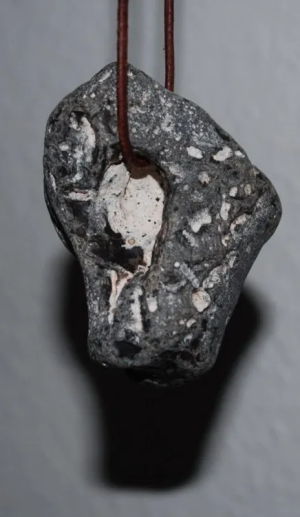
A Drudenstein is a pebble with a naturally formed hole in the center. In Bavaria, such pebbles were hung in rooms, on cradles or in stables to ward off nightmares, or to protect horses against matted manes or tails
We call those hag stones. When I was in Northern Ireland last year, I was trying to decide on a proper souvenier for my kitchen witch daughter-in-law. Looked down at my feet, and lo and behold, there lay two hag stones: one for each of us.
I'd never found one of these, but a major subplot of the Tiffany Aching books (by Terry Pratchett, well worth reading!) concerns Tiffany's attempts to find and keep hold of one of these stones (which in parts of England, especially Cumbria, is called a "dobby stone" -- and no, the term has
nothing whatsoever to do with Harry Potter).
Tiffany keeps the stone, along with other keepsakes, when she leaves her home on the Chalk to travel elsewhere and become a witch. In the books, it is considered lucky and is used for magical protection (and eventually, a type of divination).
that's so lovely. I found a French version of it, and it's breathtaking ...
Ah! Belle nuit, ô nuit d’amour … Souris à nos ivresses …
(Beautiful night, oh night of love … Smile at our intoxications…)
I have heard this barcarolle before, but it is always enchanting. Speaking of Offenbach, the first operetta I was lucky enough to be a part of (in the chorus) was
Orphée aux enfers (Orpheus in the Underworld), a comic masterpiece and probably the first operetta in history.
Although I do hold Offenbach in high regard, Gabriel Fauré is my favourite French composer, possibly because he wrote such exquisite music (especially for the voice). His
Requiem is justly famous, his instrumental
Pavane and
Sicilienne two short masterpieces, the
Cantique de Jean Racine magical ... but my current favourite (since I'm trying to learn it, but also for other reasons), is
Les Berceaux ("The Ships"):
The translation is:
Along the quay, the great ships that the sea-swells tilt in silence, take no notice of the cradles rocked by the hands of women.
But the day of parting will come, because women must weep and curious men must be tempted toward horizons that will delude them!
And that day, the great ships, fleeing from the port that grows small, will feel their mass restrained by the soul of distant cradles.
The piano accompaniment, sounding so simple, is reminiscent of lullabies and the rocking of cradles, but at the same time echoes the sailors being rocked in their hammocks by the waves. This performance is elegiac and compassionate, warm but noble.

(Sorry to go on about this. French romanticism FTW!)


 Winner: 4th Contest Feb
 Winner: 4th Contest August
 Winner: June Flash Fiction