Random Thoughts

LOL.
It's from the same musical you were quoting!

With a "little bit o' luck" this will all make sense.

Yep, it's all from "My Fair Lady" (based on Pygmalion by George Bernard Shaw). ;) I was just making a joke about how dancing all night would be dangerous, and probably even fatal, if actually attempted.

But my favourite song from that show is this one:


And then there's the English spoken here in Australia, which is another kettle of kangaroos. I went to stay at a hotel in the Outback once - early morning, the manageress flung open the curtains, put down a mug of hot tea by my bedside, and said "Here y'are, cobber! And if ya don' like sugah, don' stirrit!" ;)

Wouldn't that be loverly?

It would. And I wrote a parody of that song for people who hate housework. I called it "Wouldn't it be slovenly?" :)
 
My wife and I watched My Fair Lady and one of the versions available for Pygmalion. I concluded that My Fair Lady is the better piece, even if Shaw wouldn't have liked any ending that had Eliza and Henry in a relationship. And MFL didn't really have that ending... the characters had a sort of reassessment of each other, but they could have gone separate ways after that.

But in MFL, Henry was equally re-shaped into a different person, undergoing something of the same transformation that Eliza did. And it was Eliza who was the sculptor. That element was missing from Shaw's play.
 
My wife and I watched My Fair Lady and one of the versions available for Pygmalion. I concluded that My Fair Lady is the better piece, even if Shaw wouldn't have liked any ending that had Eliza and Henry in a relationship. And MFL didn't really have that ending... the characters had a sort of reassessment of each other, but they could have gone separate ways after that.

But in MFL, Henry was equally re-shaped into a different person, undergoing something of the same transformation that Eliza did. And it was Eliza who was the sculptor. That element was missing from Shaw's play.
I've only seen a stage production of Pygmalion but I assumed the two gentlemen living together...had no interest in relationships with ladies. Perhaps just that director's vision. It was very, very understated if it was there, but so were "lifelong bachelors" and "close friends" of the era.
 
I've only seen a stage production of Pygmalion but I assumed the two gentlemen living together...had no interest in relationships with ladies. Perhaps just that director's vision. It was very, very understated if it was there, but so were "lifelong bachelors" and "close friends" of the era.

"Bunburyist? What do you mean, Bunburyist?" ;)

Speaking of The Importance of Being Earnest, I've seen a theory that goes as follows: Jack Worthing and/or Algernon Moncrieff are "lifelong bachelors" who are forced into marriage to keep up appearances.

I am not at all sure about this. Yes, Oscar Wilde was a "lifelong bachelor", but that doesn't mean his characters have to be. *shrug* I've written quite a few characters that I'm sure have nothing to do with me (unless, say, I was a Babylonian goat-herd or a guard Captain in ancient Rome). ;)

Regardless, that doesn't alter my feeling that Earnest, as well as Wilde's most famous play, is also his best. What do you think?
 
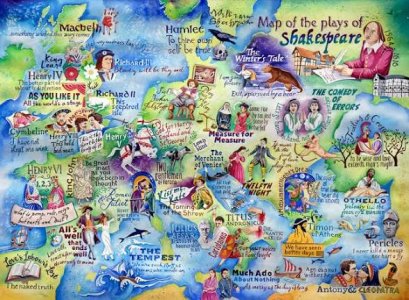
I recently started watching BBC filmed version of Anthony and Cleopatra, will try to find The Tempest and The Winter's Tale (I'm looking for a specific storyline motifs) but it can be a challenge to read/watch the plays without the translation. In terms of my acquaintance with Shakespeare, I know more about his tragedies than about any of his comedies (or historical plays, romances), don't know what the reason for this is.
 
I recently started watching BBC filmed version of Anthony and Cleopatra, will try to find The Tempest and The Winter's Tale (I'm looking for a specific storyline motifs) but it can be a challenge to read/watch the plays without the translation. In terms of my acquaintance with Shakespeare, I know more about his tragedies than about any of his comedies (or historical plays, romances), don't know what the reason for this is.

Hmm ... Pik, I did English Lit in school, and it focused on three Shakespeare tragedies: Romeo and Juliet, Macbeth, and King Lear. So, if your background is anything like mine, that's easily explained. :)

Also, I noticed that whenever Shakespeare comes up in this day and age, his tragedies (and sometimes sonnets) get much more attention than his comedies or histories. I guess a tragedy like R&J or Macbeth is easier to understand than, say, As You Like It -- or Henry V, Part 1. (It requires a working knowledge of the history of English monarchy, as well as a knowledge of the Hundred Years War and the Wars of the Roses, to understand most of the histories).

Even so, some of the speeches in the histories -- or at least some of the phrases -- are still familiar. Most of us know the expression Once more unto the breach, dear friends, once more!, but might not know the rest of the "St Crispin's Day" speech it comes from. Some of us might know the "O, for a Muse of Fire" speech that starts Henry V, but I don't know.

But it takes an actor of unusual skill to deliver these speeches properly. For instance, witness Brian Blessed deliver Duke Beaufort's menacing ultimatum from Henry V to the French king: in short, surrender your crown and kingdom, citing divine right and inheritance. Failure to comply will result in "bloody constraint" and brutal war.


Brian Blessed is famous for his booming voice, but here he conveys carefully suppressed menace that makes this scene work wonderfully. :)
 
  • Like
Reactions: Pik
Hmm ... Pik, I did English Lit in school, and it focused on three Shakespeare tragedies: Romeo and Juliet, Macbeth, and King Lear. So, if your background is anything like mine, that's easily explained. :)

Also, I noticed that whenever Shakespeare comes up in this day and age, his tragedies (and sometimes sonnets) get much more attention than his comedies or histories. I guess a tragedy like R&J or Macbeth is easier to understand than, say, As You Like It -- or Henry V, Part 1. (It requires a working knowledge of the history of English monarchy, as well as a knowledge of the Hundred Years War and the Wars of the Roses, to understand most of the histories).

Even so, some of the speeches in the histories -- or at least some of the phrases -- are still familiar. Most of us know the expression Once more unto the breach, dear friends, once more!, but might not know the rest of the "St Crispin's Day" speech it comes from. Some of us might know the "O, for a Muse of Fire" speech that starts Henry V, but I don't know.

But it takes an actor of unusual skill to deliver these speeches properly. For instance, witness Brian Blessed deliver Duke Beaufort's menacing ultimatum from Henry V to the French king: in short, surrender your crown and kingdom, citing divine right and inheritance. Failure to comply will result in "bloody constraint" and brutal war.


Brian Blessed is famous for his booming voice, but here he conveys carefully suppressed menace that makes this scene work wonderfully. :)
I've learned the same plays in school but didn't have too many literature classes at the time. In my undergrad studies other Shakespeare's plays were introduced such as Hamlet, Othello, The Tempest, one of comedies (A Midsummer Night's Dream), and I helped stage a scene from Richard III. Shakespeare and history are not my strongest points though. The writing style has a bit of disillusionment (or information overload) effect on me, I prefer the simplicity of Beckett's writing even though there's not much happening in most of his plays.
 
I've only seen a stage production of Pygmalion but I assumed the two gentlemen living together...had no interest in relationships with ladies. Perhaps just that director's vision. It was very, very understated if it was there, but so were "lifelong bachelors" and "close friends" of the era.
True. But consider that when the play opens, the two had never met before, but were admirers of the other's work. So that friendship alone would have accounted for Higgins's invitation for Pickering to stay at his place rather than seeking accommodations elsewhere. It's understandable that Higgins would not have had much companionship in his live, considering his low opinion of other people, and might have leapt at the chance to have a peer around. It's also established that Pickering was going to go back to India by and by, but Higgins didn't seemed to be distressed by that.

The shock, in My Fair Lady, is when he realizes that he does want companionship in his life, and that it was Eliza who opened that door ("I've grown accustomed to her face"*). It's only lightly implied that his desire for her was romantic, but it's blatant that he now sees how lonely his life had been before that, and that what he'd thought of as "supremely independent and content" before now looked like emptiness.

Maybe I'm interpreting it wrong, but the ending lines of My Fair Lady, where Eliza recalls her introduction to him ("I worshed my fyce and hands before I come, I did") and he responds with "Where the devil are my slippers?" mark not the beginning of a relationship, but a true friendship. They can now laugh at what they've been through, and for me, that's enough.

*About that line... when I first head it on an LP of the musical that my father had, I misheard it as "I've thrown a custard in her face," which I thought was hilarious. I still do.
 
I recently started watching BBC filmed version of Anthony and Cleopatra, will try to find The Tempest and The Winter's Tale (I'm looking for a specific storyline motifs) but it can be a challenge to read/watch the plays without the translation.

The paperbacks that the Folger Shakespeare Library published were very useful for me, because the printed the original words on the right-hand page and any clarifications on the left-hand side.

But remember that Shakespeare's words were meant to be heard, not read. A decent actor can convey many the meanings through their delivery, and a greater familiarity with the plays can pay dividends later on. I think it's like a child picking up a dialect or a foreign language simply by listening to it, and gleaning the sense of the words from context. Since Shakespeare's language is much closer to ours than, say, Chaucers's, it's not too hard to relate to it when hearing it spoken.

I remember somebody telling me, after watching a Shakespearean play, "The first two acts were hard for me to follow, but then it got really easy for me."
 
The paperbacks that the Folger Shakespeare Library published were very useful for me, because the printed the original words on the right-hand page and any clarifications on the left-hand side.

But remember that Shakespeare's words were meant to be heard, not read. A decent actor can convey many the meanings through their delivery, and a greater familiarity with the plays can pay dividends later on. I think it's like a child picking up a dialect or a foreign language simply by listening to it, and gleaning the sense of the words from context. Since Shakespeare's language is much closer to ours than, say, Chaucers's, it's not too hard to relate to it when hearing it spoken.

I remember somebody telling me, after watching a Shakespearean play, "The first two acts were hard for me to follow, but then it got really easy for me."
Some years ago I watched Macbettu, a type of physical theatre from Sardinia that the local audience really liked (adapted from the pov of witches). Yeah it's probably an acquaired taste, I know there are fields of study such as Shakespearology focusing solely on the study of his works. I have a relatively good understanding of the storylines in some of the tragedies but the dialogue and the context can be confusing. There are translations but it really does take time to read all of them. One of the things that brought me closer to Shakespeare was reading about the mysterious figure of John Dee who lived around that time, and his connection to Shakespeare's plays, e.g. the character of Prospero in The Tempest that was supposedly based on him.
 
Shakespeare and history are not my strongest points though.

No problem. History (especially English history) is one of my strong suits; I've been reading history for nigh on 30 years, and always learning new things. :)

But remember that Shakespeare's words were meant to be heard, not read. A decent actor can convey many the meanings through their delivery, and a greater familiarity with the plays can pay dividends later on. I think it's like a child picking up a dialect or a foreign language simply by listening to it, and gleaning the sense of the words from context...
I remember somebody telling me, after watching a Shakespearean play, "The first two acts were hard for me to follow, but then it got really easy for me."

That sounds right. About 10 years ago I visited England for the first time, and went to see Shakespeare done at The Globe. It was Twelfth Night. I'd never even glanced at it before, but after a minute or two of watching it at The Globe, I could understand and follow it easily. :)

Since Shakespeare's language is much closer to ours than, say, Chaucers's, it's not too hard to relate to it when hearing it spoken.

Hmm ... I agree that reading Chaucer in the original Middle English is difficult, but even that is easy compared to, say, Beowulf. Reading "The Canterbury Tales" is much easier when translated into modern English.

One of the things that brought me closer to Shakespeare was reading about the mysterious figure of John Dee who lived around that time, and his connection to Shakespeare's plays, e.g. the character of Prospero in The Tempest that was supposedly based on him.

John Dee was a very real person, a learned polymath who was a major figure in the court of Queen Elizabeth I of England (r. 1558-1603). We know that he was a mathematician, astronomer, teacher, astrologer, occultist, and alchemist. He was also the court astronomer for (and advisor to) Elizabeth, and he spent much of his time on alchemy, divination, and Hermetic philosophy. As an antiquarian, he had one of the largest libraries in England at the time.

As a political advisor, he advocated the foundation of English colonies in the Americas to form a "British Empire", a term he is credited with coining.

But since there was no division in the 16th and 17th centuries between science, religion and magic (as we have today), John Dee devoted much of his time to divination and occult practices, such as trying to speak to angels. (He wasn't unique in this, either. Sir Isaac Newton, for instance, is revered for his contributions to science, but he also spent a lot of time on alchemy, especially trying to find the legendary Philosopher's Stone that would turn lead into gold).

If you're curious about John Dee, look him up on Wikipedia. His life is well-documented. :)
 
We're very, very cultured at my house. Named our dog McDuff so we can proclaim, "Lay down, McDuff!" (Slight variation in spelling, of course.)
 
Long ago, we had a Gordon Setter named Lysistrata, usually called Lysa. Upon hearing Lysa's full name, one of my better educated friends promptly asked, "Is she spayed?" Resulted in a fine case of giggles.
 
But since there was no division in the 16th and 17th centuries between science, religion and magic (as we have today), John Dee devoted much of his time to divination and occult practices, such as trying to speak to angels. (He wasn't unique in this, either. Sir Isaac Newton, for instance, is revered for his contributions to science, but he also spent a lot of time on alchemy, especially trying to find the legendary Philosopher's Stone that would turn lead into gold).

If you're curious about John Dee, look him up on Wikipedia. His life is well-documented. :)
I will, thanks. I probably first started reading about this topic in regards to Mary Shelley's Frankenstein.
 
And, of course, there's no evidence that he ever left England, so all of those locations appealed to his sense of fantasy.
'Write what you know' is sometimes perhaps taken too literally. Writing about familiar characters in different contexts can still be considered writing what one knows.
 
Back
Top