The Philosophy Thread

Depends on what you mean by "good things" and "bad things"

Just rhetorically speaking: how does a businessman, who's also a sociopathic liar and a cheat, manage to make even more money, while the myriad workers beneath him have to eat dirt. :( (I'm thinking specifically of the various Barons of the Gilded Era, who are a prime example).

And to anyone who says that they deserved to be rich, because of trickle-down economics:

4130c671a61378f8be3254234d4ae67a521e0c57381c649d16b69d689db92d86.gif


Depends what kind of connections

Political and business ones, i.e. the kind that allow (some of) the rich to pay less tax.
 
Just rhetorically speaking: how does a businessman, who's also a sociopathic liar and a cheat, manage to make even more money, while the myriad workers beneath him have to eat dirt. :( (I'm thinking specifically of the various Barons of the Gilded Era, who are a prime example).

And to anyone who says that they deserved to be rich, because of trickle-down economics:

This introduces the idea of "how do we measure a life?" - I don't think it is by how much money you have...
 
"There's one thing that I have that you will never have," said Heller.

"What's that?" The man replied.

"Enough."

By total coincidence, I came across this poem by Kurt Vonnegut this morning -

JOE HELLER

True story, Word of Honor:
Joseph Heller, an important and funny writer
now dead,
and I were at a party given by a billionaire
on Shelter Island.

I said, “Joe, how does it make you feel
to know that our host only yesterday
may have made more money
than your novel ‘Catch-22’
has earned in its entire history?”
And Joe said, “I’ve got something he can never have.”
And I said, “What on earth could that be, Joe?”
And Joe said, “The knowledge that I’ve got enough.”
Not bad! Rest in peace!
 
This introduces the idea of "how do we measure a life?" - I don't think it is by how much money you have...

That is, of course, very true. Whether you have or had a good life does not solely depend on whether you're rich or poor.

But it's easier to focus on what you want out of life when you can afford to. Living from paycheck to paycheck isn't easy, and it's even harder when you're homeless or living in your car. :(

Having 'enough' is an interesting concept. How do you define 'enough'? Enough for what?

Moreover, does genuinely thinking that you have enough mean that you're resting on your laurels, and have no aspiration to keep striving to do more and achieve more? Or does it mean "I have enough, I am relatively secure, but I'm afraid of losing it"?
 
I think when you make the pursuit of money your main goal in life, that life will end up pretty empty.

Of course, we need to have food and shelter, but there is a lot you can endure if you have love in your life.
 
I think when you make the pursuit of money your main goal in life, that life will end up pretty empty.
It's interesting.

If I compare myself to a prolific writer: "You know what I've written that Stephen King never will? Enough."

If I compare myself to a free-climber who's always challenging himself with another obstacle: "I've climbed to a height he never will: high enough."

The format is that Scrooge lost sight of what's actually valuable in life for his pursuit of coin. What if there's nothing else that can drive him? What if no other pursuit can engage him?

Fictional example to keep things light (and it's well-written) I don't think Daniel in There Will Be Blood was ever at a personal crossroads, nor did it seem he had any regrets being alone, faffing about in his mansion at the end.
 
Last edited:
I don't think Daniel in There Will Be Blood was ever at a personal crossroads, nor did it seem he had any regrets being alone, faffing about in his mansion at the end.

Interesting. I suppose one cannot miss what one never had. But an absence is still an absence.

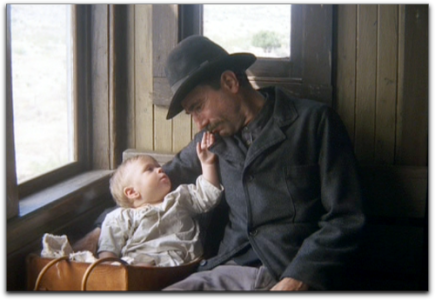
It's been years since I watched the movie, but the image that came to me this morning is the one of Daniel and the baby on the train -

1769604136112.png

No doubt, Daniel is a complicated man. (Shout out here to Daniel Day Lewis - my favourite actor) -

What took him - what motivations trumping other motivations - from this moment to how his life unfolded?

And what did Daniel mean at the end of the movie when he says "I'm finished."

 
By total coincidence, I came across this poem by Kurt Vonnegut this morning -
So that's where I heard the story! I should have known that it was Vonnegut.

He also wrote about money and the rich in God Bless You, Mr. Rosewater, in which he says that the main character is a sum of money. He introduced the concept of the Money River, to which certain fortunate people are led. These people are led to a secret bank on the river, given buckets and allowed to slurp from the river, and some of them are given bigger buckets than others. I think it's one of his best books.
 
"Enough" is a quality or quantity that's hard to pin down. On the one hand, when you have reached the pinnacle of an aspiration, like getting to the top of a mountain that you've always wanted to scale, it's totally understandable that you'd start looking for a higher mountain. But from a perspective of distance, like when you know your mountain-climbing days are over, it would be totally understandable to look back on that ascent and say "That was enough. I did what I set out to do."
 
"Enough" is a quality or quantity that's hard to pin down.

'Enough" is definitely a subjective, relative word. But, it's so versatile! Can be applied to all anything.

"'Nuff said."
"One drink is enough."
"I had enough!"
"Is that enough salt?"
"You can never have enough money." - (I heard Sharon Osborne say this once.)
 
"One must know when to stop.
Knowing when to stop averts trouble."

Lao-Tsu, Tao te Ching (Vintage 1972)
 
  • Like
Reactions: JLT
Interesting. I suppose one cannot miss what one never had. But an absence is still an absence.

It's been years since I watched the movie, but the image that came to me this morning is the one of Daniel and the baby on the train -

View attachment 854

No doubt, Daniel is a complicated man. (Shout out here to Daniel Day Lewis - my favourite actor) -

What took him - what motivations trumping other motivations - from this moment to how his life unfolded?
I think this is his way of showing love when he last speaks to his adopted son, which is showing him respect by trying to beat him down as an adversary:

Or perhaps it's not intentional, and Daniel's final rejection of the son is a sign that he's much closer to being a normal human being than Daniel ever could be. He may have never respected his son had he grown to be an ever-willing, hearing prodigy.

I have a hard time viewing the story as a tragedy. Daniel is just incapable of thinking about or being with humans a certain way. He doesn't even have a trophy wife at the end, which a stereotypical baron might be tempted to acquire.
 
"Enough" is a quality or quantity that's hard to pin down. On the one hand, when you have reached the pinnacle of an aspiration, like getting to the top of a mountain that you've always wanted to scale, it's totally understandable that you'd start looking for a higher mountain. But from a perspective of distance, like when you know your mountain-climbing days are over, it would be totally understandable to look back on that ascent and say "That was enough. I did what I set out to do."
'Enough" is definitely a subjective, relative word. But, it's so versatile! Can be applied to all anything.

"'Nuff said."
"One drink is enough."
"I had enough!"
"Is that enough salt?"
"You can never have enough money." - (I heard Sharon Osborne say this once.)
Yeah, subjective satisfaction. So why present it as a comparative virtue over someone else? I'm not implying it's mean spirited, rather it just doesn't resonate with me, which is why I tried to compare it to other abnormal goals.
And Joe said, “I’ve got something he can never have.”
And I said, “What on earth could that be, Joe?”
And Joe said, “The knowledge that I’ve got enough.”
 
Something I just read just now - a quote from William Blake (1757-1827) - that seems fitting in a previous discussion on this thread -

I possess my visions and peace. They have bartered their birthright for a mess of pottage.
 
The tree which moves some to tears of joy is in the eyes of others only a green thing which stands in the way… As a man is, so he sees.

~ William Blake
 
The only two things I remember about Blake is the poem "Jerusalem" (naturally) and the fact that he linked the history of ancient Britain with the history of the ancient Jews (mythologically and culturally) as well as with the myth of Atlantis.

So ... in essence, he's claiming that ancient Israel (before its destruction by the Romans) had something -- anything -- to do with Atlantis, a place that never existed (except in Plato's imagination). Ummmmmm ... :rolleyes: 🤣
 
The only two things I remember about Blake is the poem "Jerusalem" (naturally) and the fact that he linked the history of ancient Britain with the history of the ancient Jews (mythologically and culturally) as well as with the myth of Atlantis.

So ... in essence, he's claiming that ancient Israel (before its destruction by the Romans) had something -- anything -- to do with Atlantis, a place that never existed (except in Plato's imagination). Ummmmmm ... :rolleyes: 🤣

I figure that he's thinking of ancient Britain, ancient Jews, and Atlantans all as mythic stories, where the culture rises, blooms, and ultimately falls, either from cataclysm or invasion.

A good book to view the Jewish culture is Isaac Asimov's "Guide to the Bible," which recounts many rises and falls of that culture, wherein the power of that culture is always exaggerated. It never was as strong in the region as the Bible says it was, and was routinely gobsmacked by other cultures. It had its mythic heroes and tales of great deeds, but very little of it was historically verifiable.

Similarly, we're never sure whether Arthur really existed. He was probably not a High King, but he might have been a warlord of that era. He might even have been Vortigern, as some historians have suggested. He might have been a legendary Celtic superhero. All e know is he is the center of a mythic tale that describes the rise and fall of a man.
 
I figure that he's thinking of ancient Britain, ancient Jews, and Atlantans all as mythic stories, where the culture rises, blooms, and ultimately falls, either from cataclysm or invasion.

A good book to view the Jewish culture is Isaac Asimov's "Guide to the Bible," which recounts many rises and falls of that culture, wherein the power of that culture is always exaggerated. It never was as strong in the region as the Bible says it was, and was routinely gobsmacked by other cultures. It had its mythic heroes and tales of great deeds, but very little of it was historically verifiable.

Similarly, we're never sure whether Arthur really existed. He was probably not a High King, but he might have been a warlord of that era. He might even have been Vortigern, as some historians have suggested. He might have been a legendary Celtic superhero. All e know is he is the center of a mythic tale that describes the rise and fall of a man.

Interesting. I don't own that book, but I do have a book called "Chronicles of the Old Testament Kings" by John Rogerson, which examines those people's lives and comes to the conclusion that quite a lot of it actually is historically verifiable.

New archaeological evidence, maybe? I know it was written long after the Asimov book.
 
Back
Top