
You are using an out of date browser. It may not display this or other websites correctly.
You should upgrade or use an alternative browser.
You should upgrade or use an alternative browser.
The Philosophy Thread
- Thread starter Louanne Learning
- Start date
- Status
- Not open for further replies.


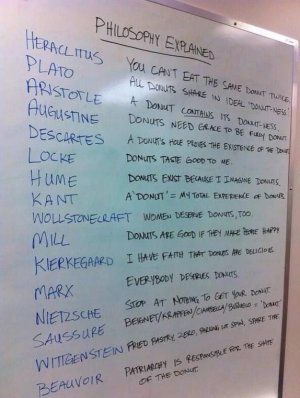


I think that the tautology conundrum here is mostly a matter of sloppy semantics, like the classic:I'm thinking about the supposed relationship between ocular prowess and spirituality or divinity. That is to say:
"What's better ... heaven or a ham sandwich?"
"A ham sandwich, because nothing is better than heaven, and a ham sandwich is better than nothing."

Squirt yourself in the eye with red jalapeño juice like I just did and ask yourself if anything besides the present exists. Jesus H... that stings!Is past and future as real as the present?

Louanne Learning
Skipping along
Active Member
 Winner: 4th Contest March
 Winner : February Poetry
 Winner: 4th Contest Feb
 Winner: 4th Contest August
But do donuts only exist in the here and now?
Louanne Learning
Skipping along
Active Member
Winner: 4th Contest March
Winner : February Poetry
Winner: 4th Contest Feb
Winner: 4th Contest August
Squirt yourself in the eye with red jalapeño juice like I just did and ask yourself if anything besides the present exists. Jesus H... that stings!
Sorry about your eye! Oweee!
I really love your philosophy. You have a fantastic way of expressing it and making it accessible.
I suppose this is an argument in favour of present being linked to past, and present cannot exist without the past.
But your pain of a moment ago no longer exists. All that exists is the pain you feel right now.

Heartlet Happer
Active Member
In a thought experiment, I sit on a couch doing nothing at 1:00PM, then a minute later at 1:01PM I choose to become really, really evil, but still doing nothing, then one more minute later at 1:02 PM I change my mind and turn into person I was at 1:00PM.Is past and future as real as the present?
Very much nothing happened, which affect the world. Except from the point of schools of thought concerned with the morality, the evil thing happened for real. I will remain unworthy of society gatekeeping the morals for rest of future time. Past is real. It will haunt me eternally. That moment of me sitting on a couch and being very evil.
If Presentism is valid, then it does not matter if I was for once and evil person. Presentism allows the evil to momentary get into existence and disappear without being checked. It gives the evil a superpower or erasure. Presentism rules allow corrupting everything including the present altogether.Presentism if the philosophical view that only present things exist … that only the present is real.
In a similar experiment. Say, if there was a scale of joy in decibels. Once I learned the certain joy say at +40 dB. a moment later that experience becomes a past. In presentism realm, that experience is no more real. Not worthy to consider. All I have in present, now, is say +10 dB. That makes the moral pursuit unguided. The pursuit has no frame of reference, it fades into apathy and closes the path to joy.
Last edited:
Louanne Learning
Skipping along
Active Member
Winner: 4th Contest March
Winner : February Poetry
Winner: 4th Contest Feb
Winner: 4th Contest August
To continue the thought experiment -
At 1:00, and at 1:01, and at 1:02, electrochemical signals were travelling in your brain, making thoughts. The structure was producing the function - your consciousness. Your consciousness, and therefore your thoughts, and therefore "the evil" has no substance. Did it exist?
But did something called "evil" enter into you? And then, from where? Does evil exist as an entity unto itself, or can it only be manifested in behavior and then only used as an adjective? We can describe behavior as evil, but thoughts, without effect, cannot be inherently "evil."
Interesting - you equate morality with joy. Would that make immoral people joyless?
Also - you touch upon the idea of past and present here. The recollection of joy helps us to anticipate joy in the future. But do memory and foresight exist outside of the function of neurons? I remember my dad when he was living, but he passed away, and he doesn't exist anymore. I remember planting flowers twenty years ago, but those moments do not exist anymore.
In a thought experiment, I sit on a couch doing nothing at 1:00PM, then a minute later at 1:01PM I choose to become really, really evil, but still doing nothing, then one more minute later at 1:02 PM I change my mind and turn into person I was at 1:00PM.
Very much nothing happened, which affect the world. Except from the point of schools of thought concerned with the morality, the evil thing happened for real. I will remain unworthy of society gatekeeping the morals for rest of future time. Past is real. It will haunt me eternally. That moment of me sitting on a couch and being very evil.
At 1:00, and at 1:01, and at 1:02, electrochemical signals were travelling in your brain, making thoughts. The structure was producing the function - your consciousness. Your consciousness, and therefore your thoughts, and therefore "the evil" has no substance. Did it exist?
If Presentism is valid, then it does not matter if I was for once and evil person. Presentism allows the evil to momentary get into existence and disappear without being checked. It gives the evil a superpower or erasure. Presentism rules allow corrupting everything including the present altogether.
But did something called "evil" enter into you? And then, from where? Does evil exist as an entity unto itself, or can it only be manifested in behavior and then only used as an adjective? We can describe behavior as evil, but thoughts, without effect, cannot be inherently "evil."
In a similar experiment. Say, if there was a scale of joy in decibels. Once I learned the certain joy say at +40 dB. a moment later that experience becomes a past. In presentism realm, that experience is no more real. Not worthy to consider. All I have in present, now, is say +10 dB. That makes the moral pursuit unguided. The pursuit has no frame of reference, it fades into apathy and closes the path to joy.
Interesting - you equate morality with joy. Would that make immoral people joyless?
Also - you touch upon the idea of past and present here. The recollection of joy helps us to anticipate joy in the future. But do memory and foresight exist outside of the function of neurons? I remember my dad when he was living, but he passed away, and he doesn't exist anymore. I remember planting flowers twenty years ago, but those moments do not exist anymore.
Heartlet Happer
Active Member
I was focusing the experiments around posted problem of something being real or not. Real past, real present. When something is meaningful then it is real. The more meaningful, the more real it is.
If the debate is about existence, synonymous to being real, then I lack the rigor to follow. I noticed a recent youtube about existence of past in view of physics science, but I did not watch it.
So, back to real, as synonymous to be meaningful or significant. The past and present are real, or else morality as a centerpiece of every possible philosophy becomes dismissed.
The future, if excluded from Eternalism, will make it easier to accept. Because the words "real", "exists", "determined" and so on are making the future in the Eternalism overloaded and complicated, maybe impossible to define as philosophy piece.
If the debate is about existence, synonymous to being real, then I lack the rigor to follow. I noticed a recent youtube about existence of past in view of physics science, but I did not watch it.
So, back to real, as synonymous to be meaningful or significant. The past and present are real, or else morality as a centerpiece of every possible philosophy becomes dismissed.
The future, if excluded from Eternalism, will make it easier to accept. Because the words "real", "exists", "determined" and so on are making the future in the Eternalism overloaded and complicated, maybe impossible to define as philosophy piece.
Last edited:


Presentism if the philosophical view that only present things exist … that only the present is real.
It’s contrasted with eternalism (past, present and future things exist).
Two different theories about how to answer the question, “What is there?”
But if presentism is the answer, how do we explain dinosaurs, memories and progress?
Some people say that dinosaurs, memories and progress are simply a collective mass hallucination based on mass hypnosis/The Man/The Lizard People from Other Space/All those drugs we did in Woodstock/Other. (Take your pick).
But here's what I think:
- The past exists because we all agree that it does. I have heard it said that the past, or at least history, is written down by the victors -- but sometimes, apparently, popular opinion is biased against the victors and decides to side with the losers instead and listen to their own twisted version of What Actually Happened.
- The present also exists, although the current present is only the present because of decisions that were made in the past.
- The future (as a concept) exists too, but at the present time, the future only exists in potentia and depends on the decisions we all make now. In other words, the future is a present from the present, but the future we get might not be the future we want.
And now that I'm done philosophising/BSing/arsing about (take your pick), I need to go and make dinner before the future contains an empty belly, 'cos that's not the future I want.


A basic tenet of my trade is that past behaviour is the best predictor of future behaviour, but it's not absolute. Change can happen and I'd be in the wrong job if I didn't believe that.
If someone is reckless enough to somehow squirt red jalapeno juice in their eye, they are not likely to try for a repeat.
Other things with less visceral negativity are more likely to be repeated. Gamblers gamble. Spouse abusers abuse spouses. Keep fit enthusiasts keep fit. Dieters diet. Many will say they've reached a new beginning. Here and now, different moment, different me. They're almost invariably wrong in my experience because that's not how change happens.
I'm in this game long enough to have observed intergenerational patterns, now dealing with the children (and sometimes grandchildren) of former clients. It can be very interesting to see how history repeats and also to see what causes it to turn out differently.
Back to theory of time, my non-scientific, untested sometime suspicion is that the future is blank, often predictable but not tangible. The past and the present are inseparable. All that we are and all we ever were are with us in their entirety during the present moment. Maybe not easily seen or recognisable, but bunched up in there somewhere. That goes for the collective as much as for the individual, with stored memory, not necessarily conscious memory, steering the actions of the individual and the society.
If someone is reckless enough to somehow squirt red jalapeno juice in their eye, they are not likely to try for a repeat.
Other things with less visceral negativity are more likely to be repeated. Gamblers gamble. Spouse abusers abuse spouses. Keep fit enthusiasts keep fit. Dieters diet. Many will say they've reached a new beginning. Here and now, different moment, different me. They're almost invariably wrong in my experience because that's not how change happens.
I'm in this game long enough to have observed intergenerational patterns, now dealing with the children (and sometimes grandchildren) of former clients. It can be very interesting to see how history repeats and also to see what causes it to turn out differently.
Back to theory of time, my non-scientific, untested sometime suspicion is that the future is blank, often predictable but not tangible. The past and the present are inseparable. All that we are and all we ever were are with us in their entirety during the present moment. Maybe not easily seen or recognisable, but bunched up in there somewhere. That goes for the collective as much as for the individual, with stored memory, not necessarily conscious memory, steering the actions of the individual and the society.
Louanne Learning
Skipping along
Active Member
Winner: 4th Contest March
Winner : February Poetry
Winner: 4th Contest Feb
Winner: 4th Contest August
When something is meaningful then it is real. The more meaningful, the more real it is.
I like this idea very much.
The past and present are real, or else morality as a centerpiece of every possible philosophy becomes dismissed.
This kind of alludes to my question about "how then could progress exist?" - if we assume morality develops out of progress
Louanne Learning
Skipping along
Active Member
Winner: 4th Contest March
Winner : February Poetry
Winner: 4th Contest Feb
Winner: 4th Contest August
a collective mass hallucination based on mass hypnosis
this presupposes the existence of a hypnotizer?
The past exists because we all agree that it does.
This is a very interesting idea (kind of related to the quote above?) - Yes, the past is woven into what we do today
It makes me think of "beliefs" - Do you mean this in the way of believing something is true?
The future (as a concept) exists too, but at the present time, the future only exists in potentia and depends on the decisions we all make now. In other words, the future is a present from the present, but the future we get might not be the future we want.
Hmm ... In what capacity do "concepts" exist? maybe here we swing around to @Heartlet Happer idea about in its "meaningfulness"
Louanne Learning
Skipping along
Active Member
Winner: 4th Contest March
Winner : February Poetry
Winner: 4th Contest Feb
Winner: 4th Contest August
I'm in this game long enough to have observed intergenerational patterns, now dealing with the children (and sometimes grandchildren) of former clients. It can be very interesting to see how history repeats and also to see what causes it to turn out differently.
I've seen two brothers - sons of an alcoholic man who beat them as children - turn out very differently. One took charge of his life and one did not. I wonder whether it was something external (for example, someone believing in them) or internal (for example, they had the better set of mental capacities to deal with it all) - that made the difference
Back to theory of time, my non-scientific, untested sometime suspicion is that the future is blank, often predictable but not tangible. The past and the present are inseparable. All that we are and all we ever were are with us in their entirety during the present moment. Maybe not easily seen or recognisable, but bunched up in there somewhere. That goes for the collective as much as for the individual, with stored memory, not necessarily conscious memory, steering the actions of the individual and the society.
This very much aligns with my take on things.
this presupposes the existence of a hypnotizer?
Agreed, which is why this view never made sense to me, and I only brought it up to be facetious.
The mere idea that someone or something is 'out there', apart from humanity, and forces us all (through hypnosis, no less) to behave in a certain way ... is either laughable or incredibly scary, and reminds me of the medieval idea that Satan somehow forces certain women to serve him and become witches, because women are "obviously" weaker and more susceptible. 
And there are so many holes in that idea, I could probably market it as a new Swiss cheese. Just supposing that Satan is real (which he isn't, since he was just made up to justify why everything sucked - "Satan did it in opposition to God!" etc., instead of everyone agreeing to roll up their sleeves and stop being so bloody stupid - but let's suppose he is): he forces women to do this? Why? To get his jollies?
I'm no theologian, but the traditional view of Hell is that geographically speaking, it's so bleedin' enormous (pardon the pun) that even trying to manage all those demons, imps, the Damned etc. is a big enough job as it is. And he wants to add more of them? Why? Hasn't he got enough to do? I mean, I've heard the saying "idle hands are the Devil's workshop", but if that's true - and Satan always wants more work to do - then he is either the laziest or the most overworked creature in the supernatural universe. (Or both! Maybe he's an incessant workaholic!)
Phew. Apologies for the rant.
 But once I started looking at it logically, I couldn't resist ... it might be the germ of a plot for a story: Satan is working so hard that he's burned out (ack! Puns!) and Payroll tells him to take time off ... *G* But where the Great Deceiver to go on holiday (i.e. where hasn't he been)? And who will replace him in the meantime?
 This is a very interesting idea (kind of related to the quote above?) - Yes, the past is woven into what we do today
It makes me think of "beliefs" - Do you mean this in the way of believing something is true?
Not quite. By saying that "The past exists because we all agree that it does", I'm referring to the stories we tell each other about the past, i.e. history.
Of course, all nations have their own histories that they tell themselves, and often they get tangled up ... which is the beginning (the starting idea) that leads to wars. "I own that piece of land, because [reasons!]" / "No, I own that piece of land, because [other reasons!]" / "Oh yeah?" etc.
Hmm ... In what capacity do "concepts" exist? maybe here we swing around to @Heartlet Happer idea about in its "meaningfulness"
As I said, a concept like "the future" exists only in potentia. It exists in our minds, we imagine what the future might hold and work towards it. Of course, other people work towards their own futures ... so the future we get might not be the future we want.
Whether other concepts (like God, Satan, Heaven, Hell) truly exist, or only do so in potentia, is a question for theologians. St. Augustine of Hippo, for instance, doubted the existence of Hell. He said that since the Scriptures said it existed, it must exist; but since the Scriptures also imply that God is merciful and full of grace, Hell was empty.
It's a nice idea, and full of hope.
Last edited:
Louanne Learning
Skipping along
Active Member
Winner: 4th Contest March
Winner : February Poetry
Winner: 4th Contest Feb
Winner: 4th Contest August
forces us all (through hypnosis, no less) to behave in a certain way ... is either laughable or incredibly scary,
But I do want to mention that cult behavior is a real thing
"The past exists because we all agree that it does", I'm referring to the stories we tell each other about the past, i.e. history.
Personal or societal?
"the future" exists only in potentia.
There's some metaphysical philosophy about "potentiality and actuality" - going back to Aristotle
Potentiality and actuality - Wikipedia
Spinoza also had a theory of power (potentia)

Power (potentia): notes on the thought of Spinoza
In this article I will focus exclusively on Spinoza’s theory of power (potentia) which forms a key element of his theories of natural right and imperium.
 criticallegalthinking.com
But I do want to mention that cult behavior is a real thing
True, which is why I mentioned the idea is scary. Personally, I think that things that makes a person lose control of themselves and/or their mind is scary.
Then again, I acted as carer for my grandmother for years, and watched her degenerate through dementia.
 So ...
Personal or societal?
Societal. I'm still young enough to vividly remember the world as it was when I was growing up.
On the other hand, reconstructing societies as they existed thousands of years ago is remarkable. Reconstructing the past of "just" 100 years ago is hard enough, never mind thousands of years.
There's some metaphysical philosophy about "potentiality and actuality" - going back to Aristotle
Potentiality and actuality - Wikipedia
en.wikipedia.org
Spinoza also had a theory of power (potentia)
Power (potentia): notes on the thought of Spinoza
In this article I will focus exclusively on Spinoza’s theory of power (potentia) which forms a key element of his theories of natural right and imperium.
This is interesting - from wiki:
The concept of potentiality, in this context, generally refers to any "possibility" that a thing can be said to have. Aristotle did not consider all possibilities the same, and emphasized the importance of those that become real of their own accord when conditions are right and nothing stops them.
Here is where Aristotle and I differ: I believe that since the future has not yet occurred, all possibilities have have the same potential to become real.
How does a 'possibility' become real of its own accord? A possibility is a concept outside human limitations, without anything driving it. It is, by its own nature, only possible -- not inevitable. If that is true, it implies there are infinite possibilities and infinite futures -- and therefore infinite future worlds (also known as the multiverse, or parallel universes).
The problem with that theory is this: is there a potential world in which, for instance, I kill another human being? My personal views on harming other human beings makes even the thought horrifying. But the theory is clear: if anything could happen without breaking any physical laws, it must happen. It hasn't and won't happen in this universe, and yet the theory of multiple universes works -- because if there was only one universe, with no branching off, none of us could ever do anything that wasn't prescribed in advance by that universe (or by a deity etc.), and humanity would be nothing but a bunch of atoms that only act according to the laws of physics.
The upshot of all this is: human agency matters! At the time of the Big Bang, the universe had worked out some of its laws, like physics, and what a carbon atom is. But then humanity came along and created its own laws, so what people do is significant! It means that the multiverse is not infinite after all, and our actions are indispensable. By our choices, we can change the universe.
Louanne Learning
Skipping along
Active Member
Winner: 4th Contest March
Winner : February Poetry
Winner: 4th Contest Feb
Winner: 4th Contest August
How does a 'possibility' become real of its own accord? A possibility is a concept outside human limitations, without anything driving it.
is not everything a matter of cause and effect?
it implies there are infinite possibilities and infinite futures
This reminds me of something I read in From Eternity to Here: The Quest for the Ultimate Theory of Time -
about using light cones to represent past, present and future -
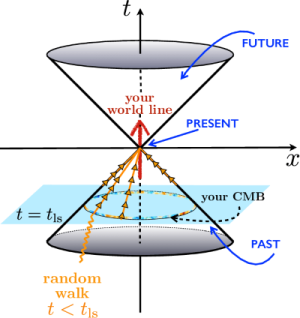
if anything could happen without breaking any physical laws, it must happen.
This sounds like determinism, and I am not too sure about that.
So may random events had to happen in order for me to appear in the universe at this point in time - from the formation of the solar system, to photosynthetic life evolving, making oxygen, to fins evolving to limbs, to my ancient ancestors surviving the migration out of Africa, to thousands of generations successfully reproducing, to my mother meeting my father.
human agency matters!
Totally agree.
But then humanity came along and created its own laws
I think you may be talking about morality here. While influenced by culture, it's also true that our morality originated in our evolution as a social species. Most morality is connected to the maintenance and survival of the group.
Last edited:
I think I've managed to answer the old philosophical question "Why do good things happen to bad people and bad things happen to good people?"
Because the bad people have great big wodges of cash and loads of connections, and the good people don't.
Connections and ready money count more than morality every time. It oughtn't to be like that. But it always is.
Because the bad people have great big wodges of cash and loads of connections, and the good people don't.
Connections and ready money count more than morality every time. It oughtn't to be like that. But it always is.
Last edited:
Louanne Learning
Skipping along
Active Member
Winner: 4th Contest March
Winner : February Poetry
Winner: 4th Contest Feb
Winner: 4th Contest August
"Why do good things happen to bad people and bad things happen to good people?"
Because the bad people have great big wodges of cash and loads of connections, and the good people don't.
Depends on what you mean by "good things" and "bad things"
Depends what kind of connections
I think stats show that having enough money to survive on increases happiness, but beyond that it is a matter of diminishing returns
But money keeps accumulating.Depends on what you mean by "good things" and "bad things"
Depends what kind of connections
I think stats show that having enough money to survive on increases happiness, but beyond that it is a matter of diminishing returns
I heard a story about Joseph Heller, the author of Catch 22. He was in a conversation with one of those men whose quest was to earn more and more money, who bragged about his latest coup and talked about getting another one.
"There's one thing that I have that you will never have," said Heller.
"What's that?" The man replied.
"Enough."
- Status
- Not open for further replies.


